Showing posts with label World War Memorial Stadium. Show all posts

Friday, April 6, 2012

Ghost Stadium

I was surprised that the city council voted to postpone the demolition of the major part of World War Memorial Stadium. If you're not familiar with what happened at this week's council meeting, Ed Cone has a brief summary with links. If you want the long history, just click the tag for "World War Memorial Stadium" below and you can read all my posts over the past years.

The council is in a quandary about what to do, so while they're waiting for another engineering report, I thought I'd try to organize my scattered thoughts.

The Preservationist Perspective

A good place to start is with the Secretary of the Interior's Standard's for the Treatment of Historic Properties. They guide all federally-funded preservation projects, and they apply to WWMS because it's listed on the National Register of Historic Places, but they are enforceable only if federal money is involved in the renovation.

Here are the standards for preservation:
  1. A property will be used as it was historically, or be given a new use that maximizes the retention of distinctive materials, features, spaces, and spatial relationships. Where a treatment and use have not been identified, a property will be protected and, if necessary, stabilized until additional work may be undertaken.
  2. The historic character of a property will be retained and preserved. The replacement of intact or repairable historic materials or alteration of features, spaces, and spatial relationships that characterize a property will be avoided.
  3.  Each property will be recognized as a physical record of its time, place, and use. Work needed to stabilize, consolidate, and conserve existing historic materials and features will be physically and visually compatible, identifiable upon close inspection, and properly documented for future research.
  4. Changes to a property that have acquired historic significance in their own right will be retained and preserved.
  5.  Distinctive materials, features, finishes, and construction techniques or examples of craftsmanship that characterize a property will be preserved.
  6. The existing condition of historic features will be evaluated to determine the appropriate level of intervention needed. Where the severity of deterioration requires repair or limited replacement of a distinctive feature, the new material will match the old in composition, design, color, and texture.
  7. Chemical or physical treatments, if appropriate, will be undertaken using the gentlest means possible. Treatments that cause damage to historic materials will not be used.
  8. Archeological resources will be protected and preserved in place. If such resources must be disturbed, mitigation measures will be undertaken.
The city-proposed plan, euphemistically called "renovation," weakly meets only the first of these criteria: the stadium will still be a war memorial, will still be used for amateur sports as it was intended, and the proposed plaza in front of its impressive triple-arched entry will give it a possible new use, since the area, if carefully and amply designed, may accommodate any number of public, civic, or patriotic activities. But it meets the standard only in an attenuated way, bringing in 30 spectators for college baseball games when once it attracted thousands.

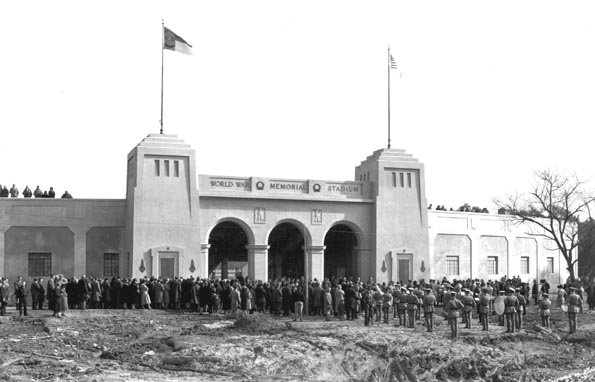
The guidelines call for "identifying, retaining, and preserving character-defining features" of the building. The National Register nomination for the stadium identified not only as its entry arches, but also the inverted "J" shape of the seating, distinctive because it is unique to the stadium. The decorated exterior masonry walls flanking the pylons are also significant, as are the distinctive windows, which still exist but have been blocked up. (You can see them on this old postcard). Finally, the canopy over the seating, though not original, has gained its own significance over time, and certainly makes watching afternoon games more pleasant.

In short, the city's proposal is a preservationist's disaster. Less will be left of the 85-year old stadium than remains of the Roman Colosseum.

At the council meeting, Bill Burckley asserted that most, if not all the significant features can be preserved for the $1.4 million the city has to spend on it, and that is why the council voted to get a second opinion on the state of the stadium's concrete. It would be great if he's right, but I have no idea whether he is.

The Neighborhood Perspective

The Aycock Neighborhood has spent a decade advocating for the preservation of the stadium, and even commissioned its own renovation plans (with a lot of help from friends like Preservation Greensboro). Its concern has been not only with the structure and its use, but its neighborhood setting. Neighborhood representatives served for years on a city-appointed task force that came up with not one, but three different plans for a "park within a park" to include not only the stadium but also the nearby tennis courts, Greensboro Farmers' Market, and the old VFW building across the street. The idea was to increase the public use of the stadium area and to use the stadium for occasional musical entertainment.

Although none of these facilities is in the Aycock Neighborhood per se, they adjoin it, and are identified as vital elements of our neighborhood life in our city-council-adopted Strategic Plan and Summit Avenue Corridor plan. While the neighborhood has been self-funding and carrying out many of the elements of those plans on its own (including streetscape improvements and signage), the city has yet to follow through on any of the promised capital improvements.

My sense is that, while the neighborhood cares very much about the preservation of the stadium, it sees it as only one element of a neighborhood improvement plan, and not the most important one. The Strategic Plan, based on a very open and careful public process, identified the improvement of Summit Avenue as our number one priority. Number 5 on that list was "prepare a plan for War Memorial Stadium and Veterans' Plaza". Veterans' Plaza is the area of public use proposed for the zone between the stadium and the Farmers' Market, and the neighborhood's current interest as a neighborhood in the stadium is mainly in that public space now that minor league baseball is gone.

Make no mistake, though: the stadium was a huge neighborhood asset when neighbors could walk on summer evenings to see the Greensboro Bats play. The city council, the Guilford County commissioners, and various city boosters at that time promised the neighborhood that the old stadium would continue to be a well-maintained and well-used neighborhood asset.

The Parks and Recreation / Greensboro Sports Commission Perspective

The Greensboro Parks and Recreation Department, which operates the stadium, has consistently been adamant (since minor league baseball left) that it wants to use it for one purpose only: amateur baseball. The primary tenants of the stadium have been NCA&T University and Greensboro College, along with some youth leagues (the infield is too big for little league). But Greensboro College has since moved on to greener infields, and the number of youth league games has declined as interest in baseball has waned.

Parks and Rec representatives on the stadium task force opposed using the stadium for other entertainments, citing wear and tear on the playing surface. And any hopes that the old stadium might attract such acts were crushed by Greensboro Coliseum manager Matt Brown, who stole a march on the WWMS renovation proponents by building the White Oak Amphitheatre, much of which he completed even before the city council knew about it.

Members of the Greensboro Sports Commission have said that there is no chance of bringing regional or national tournaments to the stadium, at least as long as Greensboro's new downtown stadium is standing. The old stadium simply cannot provide the amenities that modern athletes and fans expect (although downtown stadium boosters claimed in 2003 that "War Memorial Stadium would be an ideal location to host regional, state, and national baseball tournaments.")

Parks and Recreation and the Greensboro Sports Commission representatives have maintained that there is no need for more than a few hundred seats at WWMS, and their statements have turned out to be true for the stadium's use over the last seven years.

The Political Perspective

The current city council is facing a dilemma left to it by previous councils when they decided to build the downtown stadium and later the White Oak Amphitheatre. Those two votes assured that there wasn't and isn't going to be enough baseball or outdoor musical entertainment to make full use of the old stadium. The newer facilities have sucked the life out of the old one, and there is nothing the present council can do about that.

Even if WWMS received a full-scale preservation and rehabilitation, with all its architectural features returned to their former glory, it would still be a melancholy place -- its empty seats a silent testament to its own diminishment, and to our diminished feelings for the soldiers who died in a war almost 100 years ago that few recall or understand.

So the council will have to decide how to allocate resources to a large and expensive structure for which there is now very little use -- unless they can think of some new use for it, and make sure that it gets used.

Wednesday, May 7, 2008

St. Jude is My New Patron Saint

St. Jude is, of course, the patron of desperate and lost causes, which seem to be my specialty when it comes to bond issues. Both the War Memorial Stadium and Parks and Rec bonds that I supported have gone down in flames.

I'll let John, Paul, and George sing my theme song:


Wednesday, May 30, 2007

Um, Let's Not Do That

Retired sports editor Irwin Smallwood proposes in today's N&R:
Let's dismantle old [World War Memorial Stadium's] facade brick-by-brick if feasible, and reproduce it as a magnificent entrance way to the coliseum parking lot and as a fitting and significant memorial to those who have given their lives in all our wars.
Wow. That idea is just so wrong on so many levels. Let's start with the intended function of the stadium. Here's what mayor Edwin Jeffress said on the day WWMS was dedicated:
And so the stadium has been built by children’s and widows’ and wives’ and rich men’s wealth. It is here for the use of the coming generations; the soldier boys said they wanted no hollow granite, no useless monument to decorate our street corners, even no statuary or brass to remind us of those who have passed along after doing life’s full duty, but they wanted something that would be useful; that would help develop mind and body; that would in this way be a perpetual memorial to those who have passed…, that those of us who follow should use our best efforts to make ourselves physically fit to answer any emergency;…; and when the call to duty comes, answer with a clear, strong voice, “We are ready to do our bit.”
Mr. Smallwood is proposing to take a still useful and much-used stadium, and make of it a "useless monument" that its makers disavowed. I mean, the entrance to a parking lot?

I confess that I find Mr. Smallwood's idea of ripping one of Greensboro's major architectural landmarks from its setting, where it is much loved and valued by its neighbors, to be simply repulsive. It also goes against every good preservation principle I know. As Greensboro's historic preservation handbook says,
Each property shall be recognized as a physical record of its time, place, and use. Changes that create a false sense of historical development, such as adding conjectural features or architectural elements from other buildings, shall not be undertaken.
With all due respect to Mr. Smallwood, his idea is about the dumbest I've ever heard.

Friday, May 11, 2007

What To Make of a Diminished Thing

David Hoggard has the latest lowdown on the city's plans to dismantle most of Greensboro's World War Memorial Stadium, which will cost over $1 million.

In a guest Op-Ed for the News and Record last October, I wrote,
For about the cost of single a loaf of bread bought annually for 15 years, the average Greensboro voter can keep faith with the 80 Guilford County citizens who gave their lives for their country, and preserve North Carolina's last living and active World War I memorial. Or voters can break that faith, and pay later to have the memorial demolished and hauled to the landfill.
Time for the $1 million landfill run.

Update: Brenda Bowers, in the comments says, "I tried to tell David and others what they must do to get what they want," indicating that all that was done to preserve the stadium (by Hoggard and me and others) was write blog posts.

Sheesh.

Just to clarify: In 2002 our neighborhood hired a design firm to come up with this plan to renovate the stadium. We raised $20,000 to do so. We brought many people to several city council meetings to lobby for it.

When that failed, Hoggard and I and others served for two years on the committee that worked out the best potential uses, and then the best designs, for the stadium. We brought these recommendations to the Parks and Recreation board and to the city council.

We worked with A&T, Greensboro College, the VFW, and youth sports groups to lobby the city council to put the renovation project on the last bond referendum.

We worked with the Citizens' Committee for Greensboro to publicize the bonds in newspapers, on the radio, and on billboards. We met with neighborhood and community groups, we went on the radio, we distributed brochures and yard signs.

And we lost.

Anyhow, thanks for the advice, Brenda.

Earlier posts here, here, here, here, here, here, here, here, here, here, here, here, here, and here.

Thursday, May 3, 2007

George Clooney Visits War Memorial Stadium

I didn't get to see George Clooney or Renée Zellweger when I walked over to the stadium for some pictures of the Leatherheads shoot, but I did get a picture of a picture of George John Krazinski (last photo below).

Do I need to comment on the irony in the fact that the old stadium's charm has managed to attract the attentions of two major Hollywood productions (Bull Durham and Leatherheads), but Greensboro's own citizens were not willing to put up the money to renovate it?

No, I do not.

Anyway, here are some shots of the old girl all dressed up for George and Renée. I thought the extras looked great. Hooray for Hollywood! Click photos to enlarge.


And here's the picture of the picture of George John Krazinski.

Finally, here's a YouTube video montage that seems to evoke the period of Clooney's movie (1925), with "Hooray for Hollywood" as the soundtrack. I just like the song!


Udpate: Hoggard has more photos, and similar sentiments. And Lenslinger got some actual video of the The Man.

Update II: Neighbor Paula Patch got some pictures of George in the act of directing:


Sunday, December 17, 2006

What Is Historic Preservation?

Diane Jakubsen of the N&R's real estate advertising section wrote today about a man who built a federal-style farmhouse out of bits of salvaged historic architecture.
Although it was built in the early 1990's, the Federal-style farmhouse looks as if it has sat on its four-acre patch of land for at least 100 years ... One other fact accounts for the authentic look of Figueroa's home. Not only is it an amalgam of countless vintage parts, the house itself is a reproduction of a 1790's house still standing in Johnson County.
At first this sounds like a preservationist's dream, right? Man with a passion for old architecture preserves countless pieces of history in a beautiful showcase.

At the risk of opening myself up to the charge of being both a snob and a hypocrite, let me say that what Figueroa has done isn't exactly historic preservation.

Benjamin Briggs of PGI likes to say "every building has a story to tell," and that's one of the main justifications for preserving old buildings. Historic buildings are a tangible record of their time and place, and are valuable insofar as they are actually intertwined with our history.

So, for instance, the JP building in downtown Greensboro is significant not only because of its architectural style and detailing, but also because it is a living record of Greensboro's economic boom in the early 20th century.

The houses in Greensboro's historic districts are significant not only because they're pretty, but also because actual Greensboro people lived in them and left traces of themselves and their way of life there.

World War Memorial Stadium is significant because it is a monument of Greensboro's 1920's-era patriotism and boosterism -- the First Horizon Park of its day, if you will.

What is the story of Figueroa's house, then? Each piece in it probably has a story, but taken all together they make a cacophony of stories. The story of the whole house is really the story of Figueroa, which is certainly an interesting one, but not yet an historic one, and the project as a whole shouldn't be confused with historic preservation.

In fact, what Figureroa has done is explicitly prohibited in Greensboro's historic districts. The manual for the districts says,
Each property shall be recognized as a physical record of its time, place, and use. Changes that create a false sense of historical development, such as adding conjectural features or architectural elements from other buildings, shall not be undertaken.
So much for my snobbery ... on to my hypocrisy.

I'm nearing the end of a renovation of my dining room (got to get it done before the in-laws arrive on Tuesday), and yesterday I did the scariest part of it -- repairing the floor in a corner that went squish when you stepped on it.

I ripped out a couple square feet of the old heart pine flooring, got under the house with the black widow spiders and armadillo crickets, and nailed in some new ledger boards.

But where to find replacement flooring, as well as 1-inch thick quarter-round molding, which I also had to rip up along the baseboard? You can't buy that stuff at Home Depot; they just don't make it any more.

But you can find it at the Architectural Salvage of Greensboro, of course. ASG had exactly the salvaged pieces I needed, and it isn't the first time I've used them.

So am I doing the same thing as Figueroa? I don't think so, since I'm trying to maintain the integrity of a house that has already achieved historic significance, and using the principle of "replace like materials with like."

But I've done other things to my house that are more Figueroa-like, such as replacing the plain window casings in my kitchen with fancier fluted ones that I got from ASG. The fluted ones match the casings in the rest of my house and look nice. But if I had to do it over, I wouldn't do that again. Old-house kitchens were utilitarian places where the servants worked, and usually had no decoration. By dressing my kitchen windows up, I effectively silenced that part of my house's story.

At any rate, I don't want you to think that I'm criticizing Figueroa. I'm glad he saved all those architectural pieces and gave them a home. I just wanted to make it clear that there's a difference between what he's done and what the city is trying to accomplish in Greensboro's Historic District Program.

Tuesday, November 7, 2006

Requiem

Well, then.

Not only did the World War Memorial Stadium bond go down to defeat this evening, it went down in flames. As of 10:45 p.m. tonight, it received a lower percentage of votes than did any of the other 10 bonds on the referendum: 37% voted in favor, 63% against.

Ouch.

I spent most of the evening at a bond-referendum election-night get-together at the War Memorial Auditorium (whose bond also went down to defeat).

It was a providential blessing for me that the Greensboro Symphony happened to be rehearsing Verdi's Requiem in the auditorium, as the bond promoters watched the election results in the lobby.

I slipped into the back row, and listened in the dark to that solemn, sweet, and sad requiem as I said goodbye.

Vote Today!

Almost exactly 80 years ago today, on Armistice Day, November 11, 1926, Mayor Edwin Jeffress dedicated World War Memorial Stadium with these words:
And so the stadium has been built by children’s and widows’ and wives’ and rich men’s wealth. It is here for the use of the coming generations; the soldier boys said they wanted no hollow granite, no useless monument to decorate our street corners, even no statuary or brass to remind us of those who have passed along after doing life’s full duty, but they wanted something that would be useful; that would help develop mind and body; that would in this way be a perpetual memorial to those who have passed…, that those of us who follow should use our best efforts to make ourselves physically fit to answer any emergency;…; and when the call to duty comes, answer with a clear, strong voice, “We are ready to do our bit”
I'm heading out now to vote in favor of the War Memorial Stadium bond. Hope you will, too, Greensboro.

Wednesday, November 1, 2006

Did The N&R Do Its Homework?

Mr. Sun wonders in his comments at Hoggard's whether the N&R editorial board did sufficient research before making its bond endorsements. I'll add to his list with a few more questions about how the board went about researching its decision regarding WWMS.
  • Did the N&R read the nomination document of the stadium to National Register of Historic Places in order to find out what makes it historically significant?
  • Did the N&R read the Sutton-Kennerly engineering report on the structual decay of the stadium to find out whether it needs more than a "facelift"?
  • Did the N&R read the stadium task force's report on the recommended best uses of the stadium before doubting publicly that it will be used much?
  • Did the N&R read the report produced by Walter Robbs Calahan Pierce for the city, detailing three possible renovation scenarios?
  • Did the N&R talk to anyone in the department of Parks and Recreation, the Greensboro Sports Commission, or anyone from NCA&T, Greensboro College, or the Pony and Palomino leagues about how much they use the stadium?
The wording of their non-endorsement indicates to me that they didn't do any of these things.

If they didn't, then I have to I wonder, in the words of a friend who emailed me, "What do they do in these editorial meetings if not assemble facts?"

And is this the level of research they did for the rest of the bonds?

Tuesday, October 31, 2006

Not Persuasive

David Hoggard yesterday called out Greensboro News & Record editorial page editor Allen Johnson regarding the the paper's refusal to endorse the World War Memorial Stadium bond issue. David wrote on his blog,

During the baseball debates of 2003, you, collectively, were of the opinion that WMS should be and would be taken care of once the new downtown stadium was built. You, collectively, supported the new stadium factions who said the old stadium will be preserved and improved to become “N.C.’s premier amateur baseball venue” and intimated that opinions and fears to the contrary were unfounded.

Now, after a group of citizens (from both sides of the 2003 stadium debate) got together at the behest of city council and developed a renovation plan for WMS and got the measure placed on the ballot, you are
urging voters to reject the measure.

What changed your minds?
Allen has now responded on his own blog.

He notes that in a May 7, 2006, editorial, the N&R sort of endorsed the $5.5 million bond proposal with the words, "if the stadium is worth renovating, it's worth doing right," followed by, "as for the bigger question of whether the stadium ultimately deserves voter approval, it's premature to say right now."

I guess that adds up to, "You can't tag us for changing our mind, because we really hadn't made it up before, because even though we said the renovation should be on a bond referendum, we never said we would actually endorse the bond."

I'm going to resist the temptation to mock that kind of vacillation, and move on to more substantive issues.

Allen asks what happened to the idea of using federal tax credits. Too bad he didn't ask sooner. He would have found out that that idea had been thoroughly explored by the city, and is a non-starter. The dollars just aren't there.

Allen also seems unaware of the amount of citizen effort and city expense that went into the current bond proposal.

Former city manager Ed Kitchen assembled a task force of citizens and city staff who met frequently over a period of about two years. I was a member: we solicited public opinion and produced a recommendation for the best uses of the stadium. Then we vetted, interviewed, hired, and worked closely with an architectural consulting firm to come up with three scenarios for renovation. It was a toilsome process. I don't know how much the architects were paid, but I don't think they worked cheap.

In sum, the current proposal is the result of a planned, concerted, comprehensive, and strenuous effort by the city and by Greensboro citizens, one that the consultants involved, and the state and national preservation community, saw as an extraordinary example of citizen advocacy. It is extremely unlikely that it will be repeated.

There will be no other such initiatives to save this last-surviving world war memorial.

Back in 2003, when the city was openly debating whether to renovate WWMS or to build a new stadium, the N&R rather condescendingly scolded those of us who thought that the survival of the war memorial was at stake, and assured us that its future was secure.

Thus I find it personally galling that, when a modicum of grit was required to back up that assertion, to help make it come true, the N&R not only shilly-shallied, but now trots out a tired nostrum in its defense: "sometimes you have to make tough choices."
And as to Allen's feckless talk about a "facelift" for a structure sporting exposed, rusting rebar and whose concrete is delaminating in sheets ...

Not persuasive, Allen, to say the least. You didn't do your homework on this one, and you made a bad call.

* * *

I'd like to mention the names of some people who worked very hard to bring this bond issue forward, but who are not publicity seekers: Greg Woodard of the VFW, Benjamin Briggs of Preservation Greensboro, Marc Bush of the Greensboro Sports Commission, Willie Brown of NCA&T University, Kim Strable of Greensboro College, and Betsey Baun and Tracy Lamothe from Aycock. Most of them never missed a meeting and showed up on time. These people -- along Mark Bush, John Hughes, Stefan-leih Geary, Butch Schumate, Bob Morgan, and Richard Wagner, of the city of Greensboro, and Rence Callahan and Steve Barnes of WRCP -- did a tremendous amount of grunt work to bring forward the bond proposal, even though you haven't heard their names.

I've never worked with a nicer group of people.
Update: Here's a post from about a year ago that summarizes the history of work on the stadium up to that point. And here's a letter i wrote to the Rhinoceros Times in response to their faulty reporting on the stadium renovation planning.

Sunday, October 29, 2006

Keeping Faith

The column below appeared in this morning's News & Record; I wrote it in collaboration with Benjamin Briggs, Executive Director of Preservation Greensboro, Tracy Lamothe, a preservationist, entrepreneur, and stay-at-home mom of 3, and Greg Woodard, a retired Navy veteran and captain of VFW post 2087.


Keeping Faith

In declining to endorse the War Memorial baseball stadium bond, The News & Record wrote that replacing it with a monument of another kind would "serve the purpose [of memorializing World War I veterans] just as well."

That's not what the veterans thought.

At the stadium's dedication in 1926, mayor Edwin Jeffress said, "The soldier boys said they wanted no hollow granite, no useless monument to decorate our street corners, even no statuary or brass to remind us of those who have passed along after doing life’s full duty. But they wanted something that would be useful; that would help develop mind and body; that would in this way be a perpetual memorial to those who have passed."

In other words, the News & Record proposes that we replace the stadium with exactly the kind of "useless monument" that the veterans said that they did not want.

The 200 games a year that the stadium currently hosts assure that a renovated stadium will be well used, in the way it was intended to be used, for the forseeable future. The proposed improvements -- new locker rooms, indoor batting facilities, restrooms, and concessions -- will only make the stadium more attractive for regional tournaments.

The News & Record also suggested that a less-expensive option for repairing the stadium is preferable to the one that is on the bond referendum.

But that option was woefully inadequate. It included no seating whatsoever on the third base side of home plate, and proposed to leave the now-deteriorated 3rd-baseline seating in place, cordoned off, just rotting away. How could a partial ruin with bad seating be a fitting war memorial or even a decent sports venue?

Finally, the News & Record wrote that this isn't the "ninth inning" for the old stadium. Really? The stadium is now very seriously deteriorated, and repairs are not going to get less expensive. If this bond fails, there is no reasonable likelihood that adequate funds can be raised for repairs.

For about the cost of single a loaf of bread bought annally for 15 years, the average Greensboro voter can keep faith with the 80 Guilford County citizens who gave their lives for their country, and preserve North Carolina's last living and active World War I memorial.

Or voters can break that faith, and pay later to have the memorial demolished and hauled to the landfill.

Tuesday, October 24, 2006

Radio Blogger

I'm going to be on Dusty Dunn's show (WGOS, 1070 AM) Wednesday morning at 8:30 a.m. with Diane Davis, to talk about the Word War Memorial Stadium bond. Thanks, Diane, for the invitation.

I'll be writing more about the bonds soon.

Thursday, February 2, 2006

John Hammer Responds

My letter (previous post) was printed in today's Rhinoceros Times, followed by an Editor's note from John Hammer:
Despite repeated inquiries and requests, I have found it extremely difficult to find out the time and place of meetings, and it is illegal to hold a public meeting behind locked doors, which this committee does. According to Greensboro, North Carolina: The County Seat of Guilford by Ethel Arnett, the stadium was erected in 1922.
I checked John's reference, and Mrs. Arnett does indeed give 1922 as the date the stadium was built. Every other source I've checked, however, including the National Trust for Historic Preservation, gives it as 1926. Let's call that question a draw.

As to the "locked doors," though -- I have no idea what John is talking about. At every meeting of the taskforce that I've been to, not only was the door unlocked, it was open throughout the meeting. The door to the building has always been unlocked at meeting time, too. And the fact that John has attended these meetings seems to run contrary to his point. In fact, I can't actually find anything in the open meetings law about locked doors.

Perhaps John would have better luck at finding out meeting-time information if he actually talked to the people at the meeting, asked a city employee, "when's the next meeting?" and requested that he be put on the notification list as the law allows.

But his modus operandi at these meetings is to walk in, type madly on his laptop through the whole thing, speak only when spoken to, and leave silently at the end. No interviews, no name-address-phone-number gathering, no . . . journalism.

I assumed at the first couple of meetings he attended that he was writing down everything that was said. But almost nothing of what actually happened at the meetings made it into print (and much of what did appear was inaccurate). So it appears to me now that he uses his time in the meetings simply to re-write the same story that he's been writing now for several years, with its simple and easy-to-follow narrative arc: shadowy, powerful, and vindictive people, led by Jim Melvin, are conniving to destroy the stadium and are duping and suborning people, or subverting legal processes, to make that happen.

He simply ignores anything and everything that doesn't fit into that neat storyline.

It's odd, because I know that John is a likeable and smart fellow, and is capable of good and lively writing. The Rhino is always a good read in that respect.

But I guess I've learned first-hand not to trust it further than I could kick an anvil in my bare feet.

Monday, January 30, 2006

Letter to the Rhinoceros Times

A note of explanation: I've posted here a letter I sent to the Rhinoceros Times this morning. Much as I miss and love blogging -- and am grateful for all the very kind comments many of you have left here -- I won't be posting on a regular basis. But I hope you won't mind me putting something up here very occasionally, and thanks for stopping by!

* * * * * * * * * * * *

January 30, 2006

Dear Editor:

The Rhinoceros Times story, "War Memorial to be Shell of Its Former Self," (Jan. 26, 2006, p. 4) contained many factual errors.

Rhino editor John Hammer wrote that the War Memorial Stadium taskforce meets "in secret – in violation of the North Carolina Open Meetings Law." But in fact the taskforce has complied fully with the open meetings law. Its schedule of meetings is kept on file with the taskforce's secretary, Richard Wagner, pursuant to section 143-318.12.(4) of the law. Furthermore, the time and place of the meetings is always on public display at the place of the meeting (though this is not required by law), and is freely available to any citizen who inquires. The openness of the meeting is further attested by the fact that Mr. Hammer has chosen to attend two of them, and by the fact that at the last one he attended, on January 17, 2006, he was actually invited to participate in the discussion and voting of the taskforce, though he declined to do so.

Mr. Hammer's recounting of the history of War Memorial Stadium is also muddled. He writes that the stadium was built in 1922, although it was actually built in 1926, and that "the city" built the stadium, although it was built with private donations and only later was turned over to the City of Greensboro.

Mr. Hammer reported that in 2003 "a study was done that said that the stadium was unsafe and needed to be torn down." But the study, conducted by the local firm Sutton-Kennerly and Associates, said only that "the stadium is undergoing widespread deterioration that is not easily repaired," and identified two areas that needed immediate attention. Those problems were addressed by the City of Greensboro to keep the stadium in safe operating condition.

Mr. Hammer reported that Assistant City Manager Bob Morgan "got on the phone and found out" during the meeting that a FEMA regulation doesn't apply to the stadium, which says that no more than 50% of a structure's assessed value can be spent on its renovation if it stands in a 100-year floodplain. But it has yet to be determined whether the regulation actually applies to the stadium, and investigations are ongoing, as was made clear at the meeting that Mr. Hammer attended.

Mr. Hammer's story attributes nefarious motives to members of the taskforce, though it doesn't appear that Mr. Hammer has actually interviewed any of them. He says that "obeying state law is of very little concern to this committee, and obeying the dictates of the people who run the city is of major concern." Given that the task force has fully complied with state law, his first assertion would appear to have no foundation. As to the second assertion, if by "the people who run the city" Mr. Hammer means the citizens who will eventually pay for the stadium renovations (or not – the choice will be up to them), then his assertion must be granted. All members of the task force are very concerned that any future renovation of War Memorial Stadium must provide the taxpayers of Greensboro with a beautiful, viable stadium that will provide a maximum bang for the taxpayer buck.

But I do not think that Mr. Hammer means "ordinary citizens" when he refers to "the people who run the city." He insinuates throughout his article that the members of the task force and the Winston-Salem architectural firm which is leading the taskforce's current deliberations are somehow under the influence of Jim Melvin. If this is so, it has been completely unnoticed by me or any members of the task force that I know. If Mr. Hammer has specific knowledge of Mr. Melvin contacting and subverting the members of the task force or the consultants,Walter Robbs Calahan and Pierce (WRCP), who are currently leading our discussions, I hope he will report that information in detail. If not, I believe it would be better that he not put mere speculation in his newspaper as if it were backed up by his investigations.
What is most remarkable about Mr. Hammer's reporting, however, is how little of what actually has transpired at the taskforce's meetings has made it into the pages of the Rhinoceros Times.
Namely,
  • that the National Register of Historic Places has said that its two main concerns for the stadium are that it retain its historic function as a venue for baseball and that it remain a war memorial, and that the taskforce is fully committed to those ends;
  • that the National Register is a little uncertain about how to guide this project because it is so unusual: Greensboro is apparently a national leader in pursuing a renovation of this kind;
  • that the taskforce is working with the Greensboro Historical Museum to develop an on-site baseball museum at the stadium;
  • that the taskforce is contemplating proposing that the stadium be the focal point of a new city park, which would include the area surrounding the stadium, the Greensboro Farmers' Curb Market, and the former VFW post across Yanceyville Street from the stadium;
  • and that the taskforce has been coordinating its efforts with that of the Summit Avenue corridor study, currently underway, which will soon be proposing major improvements to Yanceyville Street as it meshes with the stadium.
Mr. Hammer often sets himself up as a spokesman for ordinary taxpayers in Greensboro, and many of us are grateful for that. If, then, he can explain why it is in the taxypayers' interest to spend millions of dollars on renovating or reconstructing thousands of seats in War Memorial Stadium which will almost certainly remain empty, rather than spending that money on upgrading an appropriate number of seats, locker rooms, restrooms, concession areas, museum, and park amenities in and around the stadium that are likely to be used by Greensboro's citizens and amateur athletes, then I look forward to his explanation.
Sincerely,
David Wharton
War Memorial Stadium Taskforce member

Monday, November 28, 2005

Assimilation?

This evening I attended a follow-up session on Action Greensboro's trip to Greenville, SC, and was asked to lead a small-group discussion that was to focus on developing policy recommendations for our own downtown.

This was a slightly-daunting task, as I didn't expect to know any of the members of my group, but it became somewhat more so when mayor Keith Holliday and city manager Mitch Johnson sat down with us. They're both very personable, however, and the ensuing discussion was interesting. (When I reported our recommendations to the larger audience, however, I experienced that nervous, my-mind-is-going-blank thing. I hate addressing large groups of strangers ex tempore.)

Anyhow, I guess this means I've been assimilated by Action Greensboro, whose plan for building a new downtown stadium I opposed so vigorously a couple of years ago.

Sam thinks this is not a good thing. But, hey, Hoggard was there, too.

Update: Hoggard says he has not been assimilated. And I should stipulate (if anyone was in dobut) that I share his views on preservation; in fact one of my reasons for getting involved with AG is to promote more preservation and adaptive re-use in its downtown activities.

Tuesday, September 13, 2005

The State of Planning for the Renovation of World War Memorial Stadium (more than you ever wanted to know)

This is going to be a very long post.

But because there's a lot of interest and a lot of misinformation about what has happened, is happening, and likely will happen to Greensboro's World War Memorial Stadium, I'm just going to pack in as many facts as I can.

Sorry if it's boring – think of it as an encyclopedia article. If you have an corrections to make or pertinent facts to add, let me know and I'll update it.


A Very Brief History of the Stadium

World War Memorial Stadium stands at the intersection of Yanceyville Street and Homeland Avenue, across the street from the Greensboro Farmers' Curb Market and a former VFW post. The City of Greensboro owns all three facilities.

WWMS was originally planned as an amateur stadium for track and field and football; an early conceptual drawing showed it with u-shaped stands and an arched colonnade all around the exterior of the stadium. That plan was never executed.

Completed in 1926, the stadium has an "inverted J" seating configuration. It has three arches at its entrance flanked by massive pylons in an eclectic mixing of classical and art-moderne styles. It is North Carolina's largest memorial to honor armed forces personnel who died during World War I. Its seating capacity is variously estimated at 5500-7500.

Early in its history the stadium began to be used for minor-league professional baseball, and that has been its primary use for most of its life. It was also used (and is used now) for college baseball by NCA&T University and Greensboro College, and for other amateur baseball teams that use 90-foot base paths.

WWMS was placed on the National Register of Historic Places in 2001. Its nomination to the Register was undertaken and paid for by the Charles B. Aycock Neighborhood Association. The stadium itself actually stands just outside the boundaries of the locally-designated Charles B. Aycock Historic District (which is listed on the National Register as the Summit Avenue Historic District).

After much civic controversy, and efforts by the Aycock neighborhood and local preservationists to keep professional baseball at the stadium (see below), the Greensboro Grasshoppers (formerly known as the Bats) in 2005 moved their minor-league franchise to a newly-constructed stadium in downtown Greensboro, First Horizon Park. In the same year, WWMS hosted about 200 amateur baseball games.


The TND Plan

In 2001, when civic leaders in Greensboro first proposed building a new stadium for the minor league team, the Aycock neighborhood was in the first stages of developing a master plan for neighborhood-wide improvements. The state of WWMS, which is adjacent to the neighborhood, had always been a concern, and plans by the Greensboro Bats to abandon the stadium raised worries that it would eventually fall prey to "demolition by neglect."

In response to the proposal for a new downtown stadium, the neighborhood engaged New Urbanist planner and neighborhood baseball expert Philip Bess to hold a planning charrette in the summer of 2002 and to draw up a comprehensive neighborhood master plan which would include a conceptual renovation program for WWMS. The neighborhood hoped that such a plan would entice civic leaders to invest in the historic stadium rather than build a new one.

That effort failed, but Philip Bess & his associated did produce in 2003 the Aycock Traditional Neighborhood District Plan (TND Plan), which illustrates many renovation possibilities for WWMS. The TND Plan also contains a wealth of conceptual plans for neighborhood-wide improvements and continues to be an important "idea book" in Aycock's neighborhood improvement efforts.

The cost of the charrette and the TND Plan was about $70,000. Money for it came from the Aycock neighborhood's Municipal Service District funds, from the City of Greensboro, from Guilford County, from Preservation Greensboro, Inc., from the Architectural Salvage of Greensboro, and from many individual contributors.


The Strategic Plan for the Aycock Neighborhood
A subsequent Aycock neighborhood planning effort, led by the city's Department of Housing and Community Development, boiled the TND Plan's many concepts down to a set of concrete goals and objectives that are contained in The Strategic Plan for the Aycock Neighborhood.

Some of those objectives relate in a very broad way to the best use and maintenance of the stadium and to improvements in the area surrounding it. The Strategic Plan was adopted as city policy by the Greensboro City Council in 2003.

The first phase of implementation of the Strategic Plan is the execution of a corridor study of Summit Avenue, part of which includes the WWMS area. As of this date, that corridor study is being done under the direction of the firm HadenStanziale, which has been charged with coordinating the corridor study with the work of the WWMS Taskforce (see below), and recommending streetscape, marketing, and transportation changes to the area around the stadium.


The WWMS Taskforce

In 2003, former city manager Ed Kitchen appointed the War Memorial Stadium Taskforce to undertake a 3-phase study of the future uses and configuration of WWMS. The first phase was to recommend the best uses of the facility; the second phase was to recommend appropriate renovations to the stadium, and the third phase would look at physical improvements in the area immediately surrounding the stadium.

Members of the taskforce include representatives of the Aycock neighborhood, NCA&T University, Greensboro College, The VFW, the American Legion, various amateur baseball organizations, The Greensboro Sports Commission, the Greensboro Historic Preservation Commission, Preservation Greensboro, Inc., the Department of Parks & Recreation, and the Department of Housing and Community Development.

The Taskforce met 6 times to complete the first phase of its work, and produced a set of recommendations for WWMS, as follows:
  • The major use of the facility should be Greensboro's premier venue for amateur baseball. The facility should concentrate its efforts on securing both the NCA&T University and Greensboro College baseball teams as regular, year-round users of the facility. Additionally, the facility should avail itself for all other amateur baseball uses that play on 90-foot bases.
  • In an effort to preserve the quality of the playing surface, it is recommended that usage should be limited to a range of 150 -200 game days (equivalent) per year. This must factor in practice times and must include the use of protective tarps for the high use areas during warm-ups and scheduled practices.
  • It is recommended that designated FT staff be permanently stationed at the facility to provide the quality playing surface that currently exists to accommodate college level play as well as enhance the City's ability to bring in tournaments to the facility. It is recommended that events, that would otherwise compromise the quality of the playing surfaces, not be allowed in the facility.
  • It is recommended that the City of Greensboro pursue the development of a baseball museum in the facility. Clearly, the historic nature of the ballpark functioning as a memorial to veterans of World War I, its proximity to an established Historic District, the facility being on the National Register of Historic Places, and its location relative to the existing Historic Museum, and Civil Rights Museum all suggest that some space be set aside to showcase the facility's history and the people who have played in it.
  • It is recommended that the City of Greensboro partner with private industry to bring a restaurant to the facility which would overlook the playing surface and would be accessible during game times as well as times when no events are scheduled.
  • It is recommended that to the extent practical, the facility be used to host concerts and civic events. Sporadic scheduling should not create unmanageable damage to the playing surface, especially if recovery periods prior to scheduled baseball events are greater than five (5) days.
  • It is recommended that the area between the ballpark and the tennis courts be evaluated for alternative uses such as croquet, bocce ball, and lawn bowling.

WWMS Taskforce Phase 2

The WWMS Taskforce began phase 2 of its work in 2004 as it searched for a planning and architectural firm to develop a set of buildable renovations plan for WWMS. Three firms submitted their qualifications for the project, and after interviewing them, the Taskforce selected the Winston-Salem firm Walter Robbs Callahan & Pierce (WRCP).

The planners have been charged by the Taskforce to come up with "good / better / best" recommendations for presentation to City Council. Whichever one is chosen by Council will likely be put up for a city-wide bond referendum.


September 12, 2005 meeting of the WWMS Taskforce

The Taskforce met on 9/12 with WRCP. WRCP led the meeting by reviewing the past planning efforts (see above) to verify that the goals for the stadium had not changed in the past few months since the Taskforce met.

Here's the checklist of items that were discussed:
  • Sports: everyone agreed that amateur baseball is a very high priority for the stadium. The primary users would be NCA&T, Greensboro College, and 16 years-and-up amateur leagues. Adult exhibition softball could also be accommodated. Other sports such as soccer, lacrosse, and track and field were eliminated from consideration because of the expenses and difficulty of maintaining a multi-use field. Accessory uses such as bocce ball and croquet may be accommodated in areas adjoining the stadium.
  • Community Events: Aycock Neighborhood representatives led by Betsey Baun and David Hoggard argued for the importance of bringing the public to this stadium, especially since amateur baseball events normally bring in small crowds. They suggested that concerts of limited duration – not all-day events such as ZoneFest – would be an appropriate use for the stadium in its neighborhood setting. Parks and Recreation staff were worried about the effect of these on the playing surface, but both groups seemed to agree that regulations for non-baseball activities could be developed to protect the field.
  • Restaurant: The idea for a restaurant with a view of the field was first proposed in the TND Plan, and the Taskforce indicated to WRCP that it should include some kind of restaurant option in its planning.
  • Museum: The Taskforce recommended to the planners that a museum of some kind be integrated into the stadium, but probably not as a separate or free-standing facility. Aycock representative Tracy Lamothe said that she had communicated informally with the Cooperstown baseball museum a few years ago, and that officials their had indicated their willingness to lend out historic items from WWMS in their possession.
  • Seating: This is the most difficult issue facing the planners. Part of the renovation plan must necessarily deal with the fact that the concrete foundations for stadium seating in the uncovered portion of the stands are so severely deteriorated as to be beyond repair, according to a report by engineering firm Sutton-Kennerly.
    Taskforce discussion focused on how much seating is likely to be needed, on the effects of reducing the seating on WWMS's standing in the National Register of Historic Places, and on whether reducing the amount of seating will limit future programmatic options for the stadium. David Hoggard and PGI director Benjamin Briggs both indicated that we simply don't know what possibilities exist for the stadium in the future, but that reducing seating too much would limit those possibilities.
    Eventually the group settled on three options: having 2,500 seats in the renovated stadium would be the "good" option; 3,500 would be "better," and 5,500 would be "best."
  • Precinct Planning: A number of options for the use and development of the areas surrounding the stadium were discussed. Many of these options – such as turning the area in front of the stadium into a public square (provisionally named "Veterans Plaza") – need to be coordinated with the Summit Avenue corridor study currently underway. All agreed that the area around the stadium need visual improvements and that potential expansion of the Farmers' Market should be considered. It was not felt that any additional on-site parking was needed.
Future Meetings

WRCP said it would digest the September 12th discussions and would plan to meet again with the Taskforce in a few weeks. In all likelihood, there will be many more meetings of the Taskforce with WRCP before concrete plans take shape.

Monday, September 12, 2005

Placemaking, Preservation, Progress

The NY Times has a terrific slideshow and article about Mississippi preservationists and residents assessing the loss of distinctive places wrought by Hurricane Katrina. Florence Williams writes insightfully about the intimate connection between people and places.
"Our concern is that people might think we care more about buildings than people, but buildings are them and their community," said Jennifer Baughn, an architectural historian for the Mississippi Department of Archives and History.
And
"You can lose what makes a place a place," Ms. Baughn added.
Indeed. One longtime Biloxi resident said,
"I'm going to miss so much the Colonial Revival homes that gave me pleasure every day, and now they're all gone. It makes me want to move away. I'm terrified of what's going to replace them."
But Ken P'Pool (sic), director of historical preservation for the State Archives tried to be somewhat optimistic:
"[The historic buildings that survived] will become the symbols of stability and continuity around which communities will rebuild."
It strikes me that communities like Biloxi and New Orleans, which have a strong sense of identity and a healthy self-regard, are likeliest to preserve their architectural heritage and use it as a jumping-off spotfor new development.
But insecure, "wannabe" cities are likelier to tear down their own architectural heritage as being "just old," and to try to emulate the lastest development fads and fashions.
Which kind of city is Greensboro? A year ago, I would have said that we're pathetic wannabes.
But the city council is now talking about re-using the old Canada Dry warehouse as an ACC Hall of Champions. Action Greensboro is helping to restore the original facade of a building downtown. And city staff and citizens are discussing ways to preserve War Memorial Stadium, albeit in a probably diminshed form. Maybe we're not such Charlotte-Raleigh-Atlanta wannabes any more: maybe we're comfortable being ourselves. I'm hopeful that the city is reaching a kind of preservation-and-progress tipping point.
Still, some people still aren't quite getting it.

Sunday, September 11, 2005

Sunday Music at War Memorial Stadium

As I was painting my shed late this afternoon, bluegrass music started drifting into my back yard.

I followed the sound over to World War Memorial Stadium, which was the site of this week's Music for a Sunday Evening in the Park. Usually the music is in a regular park; this week it was a ballpark.
The crowd was just gathering as I came in; Steel Magnolia was set up at the outfield fence. They sounded great, as did Gaelwynd a little later.

Some people have expressed concern that the city won't take care of the playing field now that minor leage ball has left this stadium for First Horizon Park. But the grass looked plush to me, even after 200 amateur games this season. So far so good. Nice job, Department of Parks & Rec.

Looking at the many empty seats, though -- many of which will probably be destroyed when the stadium is renovated -- made me feel pretty sad. I think it will be important to retain the proportions of the original seating (maybe with a berm?) in the downsized version.

Tomorrow afternoon the War Memorial Stadium task force meets with the firm the city has hired to do the renovations / alterations. I'll be there, as will Hoggard. We should start discussing soon what the future stadium will look like.
Stay tuned.

Saturday, September 10, 2005

This Morning at the Greensboro Farmers' Curb Market

Since our kids have become teenagers and our schedules have gotten busier, we don't put as much effort into cooking as we used to. And so we don't take the best advantage of one our nicest neighborhood amenities -- the Greensboro Farmers' Curb Market on the corner of Yanceyville and Homeland Avenue.

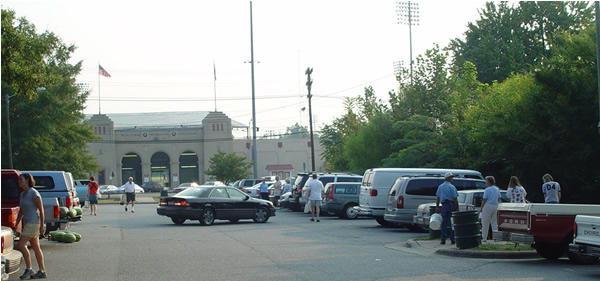
But today was just too good a day not to go. So I ambled over at about 8 a.m., and shot this nice view of the busy parking lot with War Memorial Stadium in the background (and what a handsome piece of architecture that is).

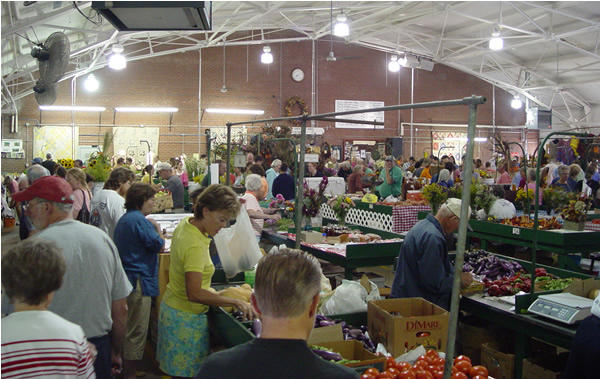
The place was really hopping, as it is every Saturday morning from Spring through Fall. Thousands come every week.

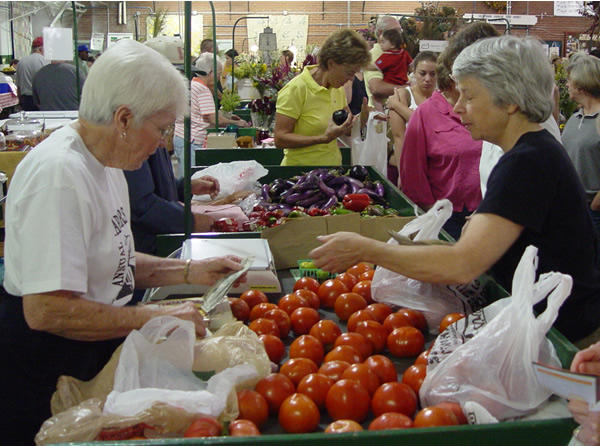
The tomatoes and eggplants are lustrous, practially luminsescent with all the sunlight they've been absorbing for the past few months.

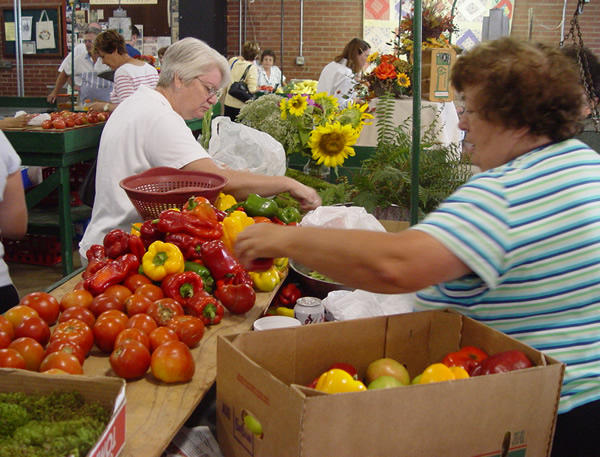
And these peppers looked so tasty and colorful that I was tempted to pick one up and take a big bite out of it like the host of the Iron Chef.

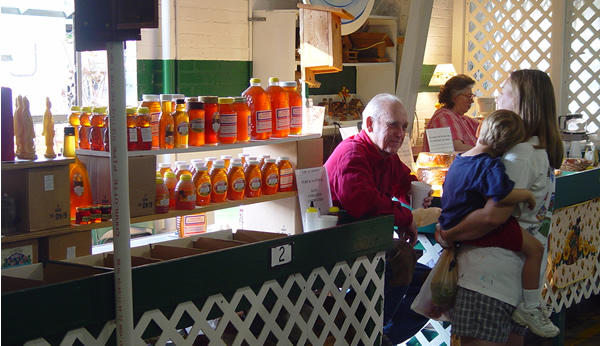
I always want to buy honey when I come here because I have a fascination with beekeeping that I picked up from reading book 4 of Vergil's Georgics too many times. But we don't actually eat very much honey, so I just took this picture of the sun shining through it while the vendor talked to my neighbor Tracy.

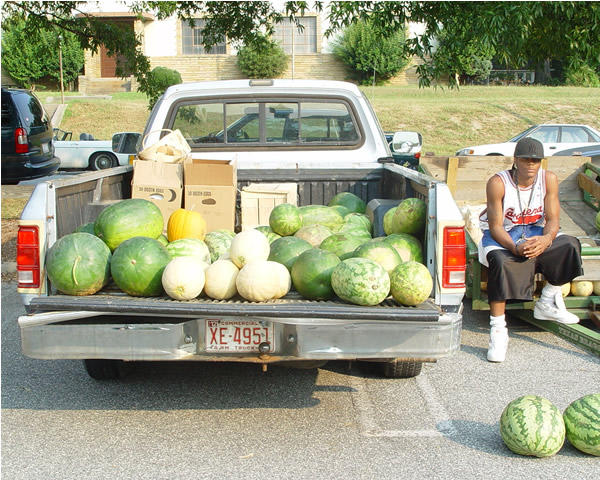
The young watermelon vendor in the parking lot seems to prefer urban dress, but I think he's realy a countryman. Either way, he's very nice, and his melons are good.

The Greensboro Principle kicks in big timewhen I'm here. What's the Greensboro Principle? It says that you can't go anywhere in Greensboro without meeting someone you know. Lately, I can't go anywhere without running into 5 or six people I know.

Among the 7 friends I met this morning was Jill Fuller, a UNCG sociology professor. She told me that not only does she come to the market every week, but she has out-of-town friends who insist on visiting whenever they're in Greensboro. It's kind of a happening for them.

The market is that kind of place -- pleasant, festive, full of local flavor (in every sense), cool, a bit funky, and just a little underappreciated by the natives.

If you haven't been there, you should really go. It's neat.

Oh, and did I mention that it has great produce? And Goat Lady cheese? and Cheesecakes by Alex? And . . . lots of other great stuff.

Monday, July 11, 2005

An Unsettling Pattern

In an earlier post, I mentioned that planners from the Project for Public Spaces had advised Action Greensboro that there's plenty of parking in downtown Greensboro.

What's needed, they said, is traffic calming to make downtown more welcoming to pedestrians. In their words, "We need to make Friendly Avenue more Friendly." They also suggested that park planners construct a painted skein to hang on one of the Center City Park's neighboring parking decks, specifically to hide the fact that the park is surrounded by parking decks.

But now Downtown Greensboro Inc., which has traditionally had close ties with Action Greensboro, has addded three new parking decks to its downtown development wish list.

This isn't the first time that downtown boosters have ignored the advice of nationally-known experts that they themselves have hired.

Action Greensboro brought "creative class" guru Richard Florida to Greensboro in October, 2003. Florida strongly promotes the revitalization of center cities as a way to rev up economic development.

And, as Fisher Park resident Ann Stringfield has documented thoroughly, Florida doesn't believe that baseball stadiums play any significant role in such efforts. She wrote:
Richard Florida, brought to visit Greensboro by Action Greensboro to promote his "Creative Class" concept, repeatedly and clearly articulates in print and in conversation that a new downtown stadium is not a good idea. Florida writes ... "Stadiums are NOT part of any package aimed at attracting the creative class. And none of our focus groups or interviews turned up stadiums as on the list of what creative class people want." (Florida's emphasis, not mine.)
So what did Action Greensboro do after bringing Florida in? They built First Horizon Park in the downtown business district. This has been their signature project. Hmmm.

And before Florida, Action Greensboro helped pay for a visit by Donovan Rypkema, an expert on historic preservation and the creative re-use of historic buildings, who has a decidedly pro-free-market orientation. Rypkema said when he was here that preservation and re-use make a lot of economic sense, and have been important components of nearly every successful center-city revitalization that he knows about.

What happened to Rypkema's advice?

The art moderne-style Burlington Industries building was torn down to build First Horizon Park. To date -- and as far as I know -- Action Greensboro hasn't preserved or renovated a single historic structure. Hmmm. Hmmm.

Now, in principle, there's nothing wrong with disagreeing with experts. Experts are often wrong -- sometimes they're spectacularly wrong. If Action Greensboro and DGI had ever said anything like, "We disagree with Rypkema, Florida, and the Project for Public Spaces. It was a mistake to bring them in. We have a different idea, and here it is . . ." that would have been great. Let's do have an open discussion about the best way to promote downtown development.

But that has never happened. Rather, a series of experts has been brought in, and their advice has been quietly ignored. More than ignored -- contradicted.

What gives? Action Greensboro folks (and I know that at least one reads this blog) -- please tell me why I shouldn't intepret this pattern as a very cynical way to build public support for an agenda that has little to do with expert advice.

Because I'd love to believe that things in this city don't work the way that the cynical me thinks they do.

So cynics (you know who you are), please refrain from commenting. I want to hear from the other side: un-convince me.