Wednesday, May 7, 2008

St. Jude is My New Patron Saint

St. Jude is, of course, the patron of desperate and lost causes, which seem to be my specialty when it comes to bond issues. Both the War Memorial Stadium and Parks and Rec bonds that I supported have gone down in flames.

I'll let John, Paul, and George sing my theme song:


Monday, May 5, 2008

Go, Greenway, Go

I'm going to vote tomorrow for the Greensboro Parks and Recreation bond, which includes $4 $2 million for the Center City Greenway. It's the only bond item the News & Record didn't endorse. A good friend told me last night that he was "looking for a reason" to vote for it, and I told him I'd offer mine.

I live only a block from the Greenway's proposed path, so you could say that I'm for it out of pure self-interest, and that wouldn't be totally wrong. The Greenway would improve my quality of life tremendously by letting me walk and bike in a nice environment to places where I have to drive now because current roads are dangerous for bikers and nasty for walkers.

But what benefits me also benefits thousands who live in Greensboro's "ring" neighborhoods: Fisher Park, Westerwood, Latham Park, Southside, East Market St. These are neighborhoods that have mostly received the short end of the transportation stick for the last half-century. Or I should say, the sharp end of the stick (as in "a sharp stick in the eye"). There are also some neighborhoods not named here because transportation projects that were intended to benefit commuters simply wiped them away. In their place now are low-income housing projects like Cumberland Court that barely function as neighborhoods at all.

A little history: in the mid-20th century, city and transportation planning was all about modernist ideals. Center cities would tower with gleaming skyscrapers, and happy workers would commute briskly to and from the suburbs on efficient superhighways or live in hive-like high-rises. Traditional modes of urban living (called "neighborhoods") and the older buildings that accommodated them were declared "blight" and "slums." Many of them were razed to make way for "urban renewal" and transportation projects, and their hapless denizens were relocated to modern housing projects.

As we all know now, this great civic project was one of the great failures of the 20th century, and the planners made an urban wasteland of many of America's great cities.

Greensboro's Murrow Boulevard is a good example of this. Its six mostly empty lanes ripped though the urban fabric on the east side of downtown Greensboro, leaving almost nothing intact from Lee St. to Summit Avenue.

However, suburbanites were mostly happy with these projects, because they were effective at moving cars to and from the city. When center cities collapsed and crime skyrocketed in the 60's, suburbanites responded by moving further and further from the cities, and transportation dollars followed them.

Only in the past couple of decades have planners embraced the idea of reinvesting in neighborhood-friendly urban transportation infrastructure. In Greensboro, bonds supported the Southside and East Market transportation projects. Both of them have been very successful.

The Greenway is another such project that will continue to re-weave the urban fabric that was so ripped and tattered by mid century misunderstandings of how good cities work, and make Murrow Boulevard (among other streets) work for the city dwellers who live there rather than for commuters who just want to drive through as quickly as possible.

The future of transportation in America and in Greensboro will not be like the past. It seems undeniable now that we will be facing higher gas prices for a long time -- maybe forever. And the new generation of Americans seems more interested in living in cities than their boomer parents and grandparents were. Making the city a nicer place to live will attract more urban dwellers to Greensboro, meaning that less countryside will be devoted to suburban development, and fewer transportation dollars will have to follow commuters out to the exurbs.

So I'm voting for the Parks and Rec bond.

Friday, March 14, 2008

Greensboro Neighborhood Congress Writes Complaint to DOJ about City Council Redistricting

The Greensboro Neighborhood Congress has serious qualms about the city council redistricting that happened in such a hurry-up, back-room-deal kind of way recently, and has written to the Department of Justice to complain, not only about the way the redistricting happened, but also about the disadvantages of "Plan Q," the adopted district map.

Update: Tony Wilkins says in the comments, "Can you be specific as to what this means: "Plan Q has obvious political benefits for certain elected representatives and less obvious impacts for some business"? If you're going to make this allegation you should be specific."

I can't speak for the letter-writers, and I wasn't present at the meeting where this was discussed. But Plan Q splits many neighborhoods into different districts, and thus dilutes the political clout of those neighborhoods with the Council. Since unified neighborhoods often oppose the plans of real estate developers like Councilman Matheny, maybe this move is seen as an effort to increase the real estate industry's control over rezoning cases.

Here's the whole letter:

March 12, 2008

Don Jacobsen
Voting Section
Civil Rights Division
Room 7254 - NWB
Department of Justice
950 Pennsylvania Ave., N.W.
Washington, DC 20530

Re: City of Greensboro, NC Council Districts

Dear Mr. Jacobsen:

We are writing as Co-Chairs of the Greensboro Neighborhood Congress (GNC), at the direction of the GNC membership, to express the GNC’s strong displeasure concerning the City of Greensboro’s recently adopted City Council redistricting plan that is currently under review by you and other United States Department of Justice personnel. The GNC is a 501 (c) (3) nonprofit organization comprised of neighborhood organizations representing neighborhoods located throughout Greensboro. We currently have 43 member neighborhood organizations that include more than 16,000 households. These neighborhoods are located throughout Greensboro’s five City Council districts, making the GNC one of the most socio-economically and racially diverse organizations in Greensboro. The mission of the GNC is to address issues of citywide concern to neighborhoods and to empower neighborhood leaders to address their specific neighborhoods’ own issues of concern. We focus on advocacy for the improvement of the quality of life in Greensboro neighborhoods and on the education of neighborhood leaders.

On February 19, 2008, our City Council voted to adopt what is known as redistricting “Plan Q” over other redistricting plans, including a “Plan B” that had been recommended by City staff. (We believe that you have been asked to review both the adopted “Plan Q” and the alternative “Plan B.”) At a meeting on March 8, the GNC membership in attendance voted unanimously to comment to the United States Department of Justice to protest the procedural deficiencies involved in the adoption of Plan Q, as well as the substantive deficiencies in Plan Q relative to Plan B. We are writing this letter to you in accord with that mandate.

The GNC membership is particularly dismayed with the manner in which Plan Q was adopted. Unlike Plan B and most of the other plans that were made available for public review and comment well ahead of the Council’s February 19 meeting, Plan Q was unleashed on the public for the first time during the Council’s meeting, by its sponsor, Council Member Zack Matheny, who is the District 3 representative. (In fact, The GNC has been informed that some of the Council Members themselves had only 24 hours or less to review Plan Q prior to the Council meeting.) The public had no opportunity to review any maps depicting the impact of Plan Q before (or even during) the Council’s meeting at which Plan Q was adopted. It is hard to imagine a decision more fundamental to our Country’s democratic processes than a redistricting that will deprive some voters of representation by the candidates they voted into office. For our Council to have made such a decision by adopting an alternative that the public was denied access to until after the fact is simply repugnant. We urge you to reject Plan Q for that reason alone.

We also want to make sure that you are aware of the substantive inferiority of Plan Q relative to Plan B. Plan Q results in 26 voting precincts being shifted from one district to another, whereas Plan B would have shifted 3 precincts. This means that, absent your intervention, voters residing in 26 of Greensboro’s precincts (about one third of the total precincts in the City) will find themselves represented on July 1, 2008 by a candidate whom they did not have the opportunity to vote for in the general election on November 6, 2007. To deprive this many voters of the opportunity for representation by a candidate they had the opportunity to vote for (or against) is a serious usurpation of democratic processes. Plan Q also will split 11 neighborhoods whereas Plan B would split only 5, and the current districting splits 6 neighborhoods. Plan B would therefore result in one less split neighborhood than the status quo, compared to Plan Q, which will double the number of split neighborhoods.

Moreover, Plan Q has a more insidious impact. Under the current districting, Districts 1 and 2 are “majority minority” and Districts 3 and 4 are “majority majority,” whereas District 5 is almost balanced with 47.5% minority population. What this means is that our City’s most likely opportunity to have a third district represented by a minority candidate is in District 5. But Plan Q would dilute the minority population in District 5 down to 41.3%, undermining the prospect of a minority candidate being elected in District 5, and making it unlikely that minority representation on our Council will have any prospect of increasing in the foreseeable future. This is a serious impact, and although some of it is inevitable given that the areas recently annexed by the City have a primarily white population in District 5, Plan Q’s magnification of that dilution relative to Plan B constitutes another serious substantive flaw in Plan Q.

Because Plan Q is flawed substantively compared to Plan B in so many respects, it renders the procedural deficiencies attendant to Plan Q’s adoption all the more suspect, and begs the question of whether Plan Q’s conception and 11th hour unveiling was engineered by special interests. Plan Q has obvious political benefits for certain elected representatives and less obvious impacts for some business interests.

For the reasons set out above, the GNC strongly urges the United States Department of Justice to give Plan Q the strictest scrutiny, and to reject it in favor of Plan B.

Sincerely,

Kathleen Sullivan
Co-Chair
Greensboro Neighborhood Congress

Art Davis
Co-Chair
Greensboro Neighborhood Congress

Tuesday, March 11, 2008

A Short Video History of Summit Avenue

I've enjoyed working with my neighbors over the past several years on planning for improvements on Summit Avenue, which I live near. Here's a short video summarizing what the my neighborhood has done so far.


I'm hopeful that the Summit improvements will be included in the next transportation funding package.

Tuesday, January 29, 2008

Glenwood Plan Goes to City Council

Update: the Glenwood plan was approved by City Council on Feb. 5. Congratulations, Glenwood!

From an e-mail circulated to the Greensboro Neighborhood Congress:

The Greensboro City Council will hold a public hearing regarding formal adoption of the Glenwood Neighborhood Plan during its meeting next Tuesday, February 5. City Council meetings are held beginning at 5:30 pm in the Council Chambers (2nd Floor) in the Melvin Municipal Office Building (City Hall), 300 West Washington Street.

Anyone who lives in, works in, owns property in, attends school or church in, or has other ties to Glenwood is encouraged to attend! If you are unable to attend in person, but would like to watch the meeting as it happens, you can do so on both Cable Channel 13, and on the internet here.

If the City Council adopts the Plan during this meeting, the Plan will become
official City Policy for all matters affecting the Greater Glenwood Neighborhood. The Plan will function as an amendment of the City's "Connections 2025" Comprehensive Plan. This is the final step in developing the Glenwood Neighborhood Plan and the FIRST STEP in implementing the plan!
The Glenwood neighborhood is working really hard to keep it a livable place. It has a very active neighborhood association and lots of distinctive local culture. I hope the new council will reward their efforts.

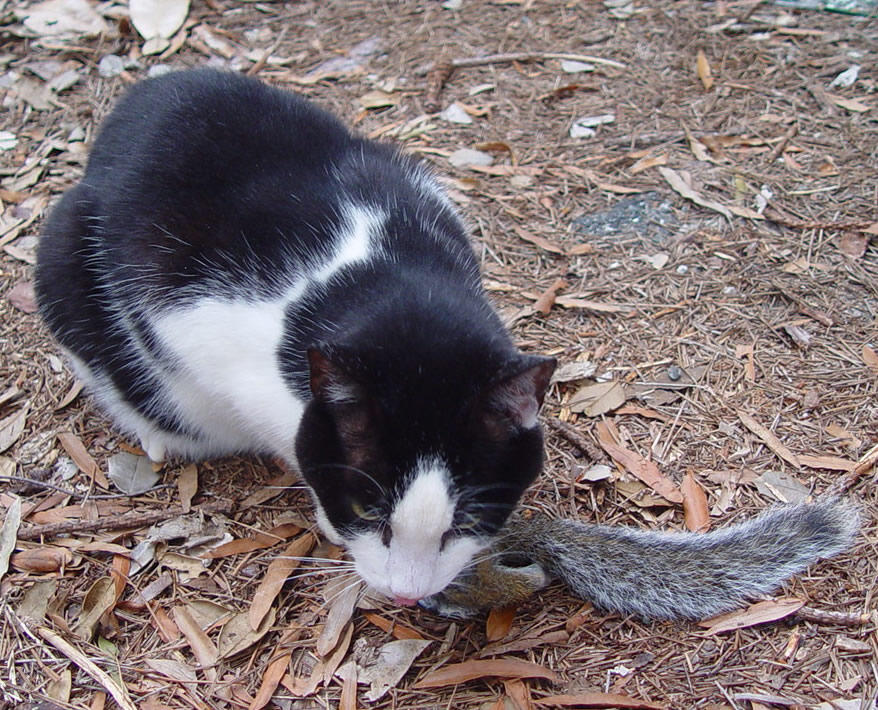
Bito the Cat, RIP


Bito the Cat passed away yesterday at Greensboro's North Elm Animal Hospital after a lengthy and courageous battle with cancer. Diagnosed last May, he endured his illness in a heroic manner worthy of his namesake. He died while licking turkey puree off a tongue depressor, surrounded by his family.

An accomplished hunter, Bito was unloved by the small animals and birds in his neighborhood. He is pictured above engaging in his favorite activity, eating squirrel, though not in his preferred dining spot (under his owners' bed).

His gregarious and outgoing personality, combined with a high tolerance for vigorous patting and tail-pulling, made Bito popular with neighborhood children. His habit of draping himself over his owners' heads in the middle of the night, however, will not be missed, though his cheerful and insouciant manner will.

Office Depot Listened to the Neighbors

A year ago I groused about the way a new Office Depot store had been built, and even made a short video about one of its signs. The main idea was not that neighbors didn't want the store near their homes; it was that the design of the store and the sign weren't appropriate for their setting.

I didn't do anything more about it after that, but a bunch of my neighbors in both the Aycock and Fisher Park neighborhoods did. They kept writing and calling Office Depot, and organized a petition and neighborhood boycott.

Office Depot finally paid attention and removed the offending sign last week. That was a nice thing to do, since Office Depot was not legally obligated to do it. Thanks, Office Depot.

Just a thought: all the efforts of the neighbors, and the wasted expense for Office Depot in putting up then taking down the sign, could probably have been avoided if someone from the company had met with the surrounding neighborhood associations during the planning process.

Tuesday, December 18, 2007

Brutal Preservation

Charles Paul Freund writes about the preservation paradoxes swirling around an architecturally-unloved 1970s-era Christian Science church in Washington, DC:

So why has the city's Historic Preservation Review Board unanimously declared the Third Church of Christ, Scientist to be an official D.C. landmark, preventing not only its demolition, but even its unauthorized alteration? Because, it turns out, it is a sterling example of the mid-century school of design known as Brutalism.

... Brutalism's preservers remain vulnerable to the ironists. That's because the church is question is exactly the kind of building that energized the city's grassroots preservation efforts in the first place. Of course, the activist preservationists of decades ago were hardly seeking to save such buildings as this church; many were seeking to prevent them from being built at all (at least in an urban context).
Our fair city has quite a bit of Brutalist architecture, including the Melvin Municipal Office Building, aka City Hall. Sometime in the next generation, people are going to start talking about tearing it down, and we're going to have to decide whether to keep it.

Via Instapundit.

DIY Downtown Design Coming to Greensboro

At the last meeting for the Downtown Design compatibility manual, the steering committee agreed that we should fire the consulting firm that was supposed to be writing up our new downtown design guidelines.

Everyone in the group was a little surprised to hear from our city staff leader, Mary Sertell, that Cooper Carry, a prestigious Atlanta design firm, had failed to produce acceptable draft guidelines out of the materials we had sent them last summer. Cooper Carry had previously done good work here in producing Action Greensboro's conceptual plan for downtown. The city sent a termination notice on December 13, and Cooper Carry's contract will end on January 17, 2008.

The downtown design committee, which is composed of city staff and volunteers from the development community, Action Greensboro, Downtown Greensboro, Inc., and regular citizens like me, earlier had agreed on a "geographical" approach to downtown design. We mapped out zones in the central city with distinctive features and building types, and turned our findings over to Cooper Carry. They were supposed to develop design guidelines for each zone.

Firing Cooper Carry will save the city, Downtown Greensboro, Inc., and Action Greensboro somewhere in the neighborhood of $90,000 dollars, but the group and city staff are going to have to roll up our sleeves and do a lot more work.

Some prominent downtown developers suggested we look at the successful design manuals of cities like Charlotte and Durham, and adapt the ideas that we think work best. And that's where we're going to start.

Sunday, December 16, 2007

Sauce for the Gander

Mike Clark, the N&R columnist on language, writes today about how "language sticklers" like him tend to drive friends and family nuts with their linguistic policing. Mike also drives me a bit nuts, because I believe that such policing has little to do with a love of language and much to do with a desire to control others.

Besides, the notions of "correctness" that get used in these exercises are quite arbitrary, and are often just a matter of imposing past conventions -- real or imagined -- on present speech. I find that policers of language impose their standards inconsistently, or, worse, are guilty of the same crimes that they accuse others of.*

(*No, it is not incorrect to end a sentence with a preposition, and if you don't like it, it's just something you have to put up with.)

In fact, Clark's column today is full of the kinds of little errors that he likes to find in others.

For example, he writes,

However, at home it seems to go differently.
Passing over the vague reference of "it," which doesn't refer clearly to anything in the preceding context, I'll ask why Clark doesn't know that "however" should be postpositive. According to Strunk's Elements of Style, "In the meaning nevertheless, ["however" is] not to come first in its sentence or clause ... When however comes first, it means in whatever way or to whatever extent."

Clark also writes,

Evidently, there was an infinitesimal catch in my voice. A teeny tone thing that gave me away.
In proper usage, "infinitesimal" means "an infinitely small amount, too small to be measured or reckoned." How could something so small be evident? According to the Oxford English Dictionary, Clark's usage, meaning "very small," is only found in "loose or hyperbolic" speech. Tsk.

Furthermore, "tone thing" is redundant. A tone is of necessity a thing; the word "thing" adds no meaning to the phrase. Why not just say "a teeny tone"? Even worse, "A teeny tone thing that gave me away" is not a complete sentence; it's a mere fragment.

Clark continues,

Then I explained that when you write a check, you want to hyphenate numbers with "ty" in the first part ...
Hmmm. "You want"? I think he means, "you ought." "Want" as a modal verb showing obligation or necessity is not listed at all in the Oxford English Dictionary.

Clark goes on,

We know that our desire for correct punctuation, spelling and usage is based on the fact that language is the building block of thought, of communication.
"[T]he building block"? Really? How can you build something with just one block? That's a failed metaphor, and it's factually incorrect to boot. We have many non-linguistic thoughts, for example when we compose, play, or listen to music. And we communicate with gesture, posture, and facial expressions as well as with language.

Later in the column he writes,

They're more than willing to say, "What's the rule for commas and quotation marks?"
If Clark meant to be precise, he would have written, "What are the rules ..." unless he meant to say that there is a single rule for the use of both commas and quotation marks. Or is he talking about some rule concerning the proper relationship between commas and quotation marks? At any rate, he hasn't made himself very clear.

Still further down, he writes,

Catherine, I am happy to report that "alright" is still considered nonstandard, even though it has become increasingly commonplace since it first appeared (in the 19th century).
Clark should have avoided the passive voice in "is still considered" (see Strunk again), but the passive is convenient for him, because it allows him to avoid saying just who, exactly, considers "alright" to be nonstandard. Furthermore, there is no reason put parentheses around "in the 19th century."

And Clark probably doesn't really mean that "alright" has become more commonplace ("devoid of originality or novelty" -- OED); he just means that it has become more common.

Had enough? Me too. I hope you found this post completely irritating. Because there really isn't much wrong with the style, grammar, or punctuation of Clark's column. My point was to show, by example, the pointlessness of being a language policeman.

Tuesday, December 11, 2007

Some Suggestions On Where to Find That $500,000

The city council met tonight in an emergency session devoted to Greensboro's recent rash of murders, and instructed city manager Mitch Johnson to find $500,000 in the budget to give to the police department.

In a pinch like this, it's always most tempting to take the money from places where you think you won't rouse much organized opposition, such as in poorer neighborhoods that usually don't have neighborhood associations -- or even very many homeowners. Those places get the bulk of funds from departments like Housing and Community Development.

I think it would be a bad idea to take planning and infrastructure dollars from those neighborhoods, mostly because their already poor civic infrastructure contributes to crime and economic underperformance. Those areas need more money to fight crime, not less.

But we are spending money on some pretty pricey items which -- although they're beautiful -- could take a hit until tax dollars become more plentiful. Here are my picks:

Hagan-Stone Park. It's outside the city limits, where we also maintain a little-used pool. We don't need a city park that's in the county.

Bryan Park golf courses. They're wonderful (I hear), but should a city be paying to maintain championship golf courses when we can't protect our citizens from gang murders? The Gillespie Park course should get us through until crime is under control; the Bryan courses belong in the private sector.

The Botanical Gardens. They're beautiful, expensive, and inessential. Exotic plants or police protection? Hmmmm. I think we can cut back a bit on the plants for a while.

Tuesday, December 4, 2007

Lingua Latina in Temporibus

The New York Times says, Hooray for Latin:

As much as opening the concertina enlarges your imagination, squeezing it shut — translating English into Latin — sharpens your prose.
Years of reading and writing Latin have had some effect on the way I write, I'm sure -- though whether for good or ill, I can't say. I also liked this bit:
With a little Roman history and Latin under your belt, you end up seeing more everywhere, not only in literature and language, but in the classical roots of Federal architecture; the spread of Christianity throughout Western Europe and, in turn, America; and in the American system of senatorial government.
I've heard classicists quote Cole Sear on this point: "I see dead people." American culture is suffused with classical culture, but few see it.

Learning Latin and Ancient Greek is hard, but I rarely hear anyone who put in the effort to do it well say that it wasn't worth it. For most, it's a source of satisfaction and a path to interesting insights throughout their lives.

Update: Somebody could use a little classical eduction. Sheesh!