Saturday, October 22, 2005

GDOT Softening on Bike Lanes? (or) Is Crunchy Culture Coming to Greensboro?

I dropped in on one of GDOT's pedestrian, bicycle, and greenway master plan workshops last week and was pleasantly surprised by the good turnout: there were about 40 people there (many more than attended the workshop that John Hammer covered in this week's Rhino Times).

That might not sound like a lot of people, but it's a lot more than I usually see at these kinds of local policy wonk-o-ramas -- more even than attended one presentation of Greensboro's Comprehensive Plan, which was a much bigger deal than this.

What was more surprising: the workshop was in Summerfield, a northwest exurb of Greensboro. I had expected folks from this part of the county to be dedicated car commuters -- but no. It turns out that lots of suburbanites in NW Guilford County want more sidewalks, trails, and bike lanes. In fact, they want bike lanes or trails from the city out to their suburbs and exurbs.

Sometimes it's fun to have one's expectations exploded.

The attendees were also asking for the kinds of things that usually get asked for at these affairs, like more and better pedestrian crossings and better sidewalk connectivity between neighborhoods, and they were busily marking up maps the city had provided for that purpose.
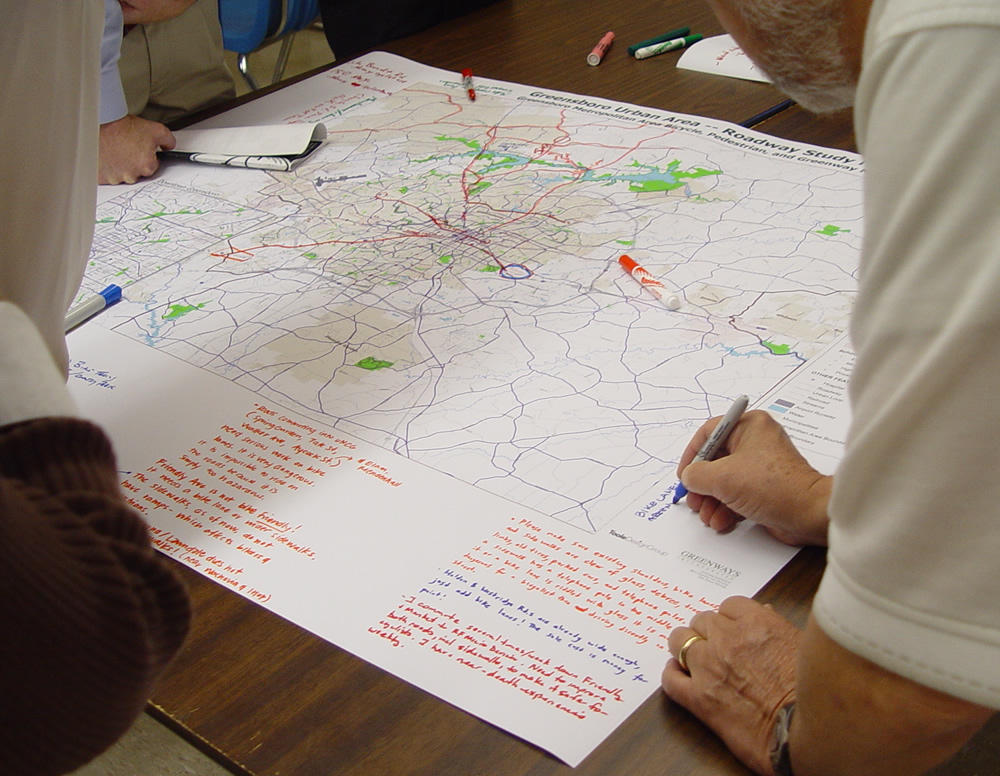
There were representatives there from UNCG's Student Government Association, too, lobbying for non-car connectors between Greensboro's many colleges and universities.
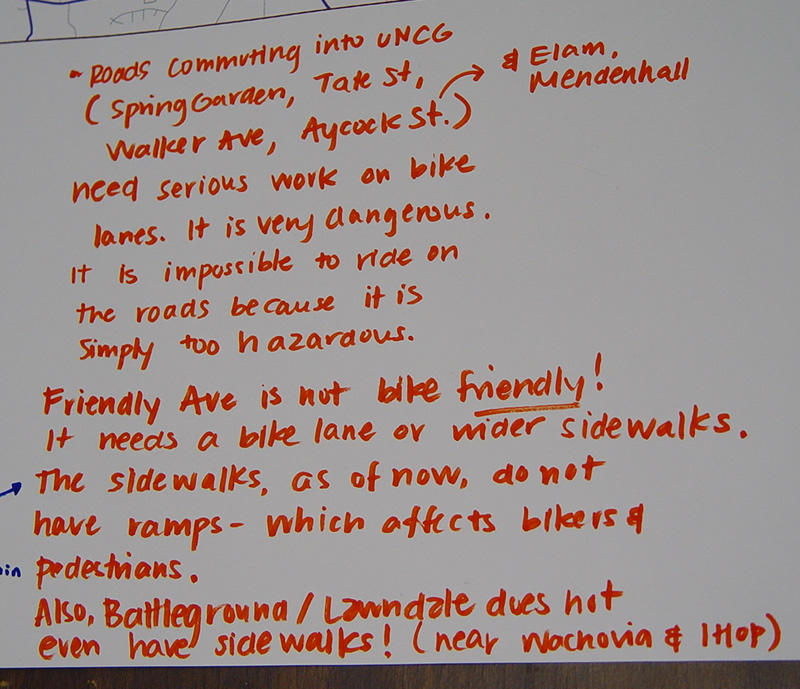
The most surprising thing I heard was that GDOT's higher-ups may be softening their previous hard stance against bike lanes. The word I've always heard from that quarter is, it ain't gonna happen.

But now GDOT staff are making noises that sound more like, maybe could happen in some places as a part of the overall pedestrian / greenway / bicycle master plan.

In some ways, I think the presence of bike lanes would change the semiotics (how's that for a fancy $2 word) of our streets as much as they could improve safety for bicyclists.

Bike lanes are communicative: their presence is a visible sign of public approval -- even encouragement -- of alternative kinds of transportation, and, consequently, of unconventional ways of living.

The presence of bike lanes in a town shows an institutional approval of a certain kind of cultural "crunchiness" that seems (to me) to be bound up with a bohemian and / or university town ethic and aesthetic.

And that would be a big change for Greensboro.

Getting the Lead Out of the Historic Districts?

My friend David Hoggard, who restores old double-hung windows for a living (and does a damned good job of it), thinks that a proposed new lead paint abatement law might put a dent in his business and run headlong into -- and right through -- Greensboro's historic district preservation guidelines.

Here's where they collide: sometimes you can't get enough of the leached-in lead out of old woodwork, especially windows, to satisfy federal guidelines, even if you strip it to the bare wood and repaint it well. At that point, you have to rip out the old, lead-laden windows and replace them.

But Greensboro's historic district design guidelines say "removal of historic materials shall be avoided."

Of course in such cases, the lead-abatement law wins. Kids' health trumps historic windows every time, and I can't imagine Greensboro's Historic District Commission thinking otherwise for even a second.

But I don't actually think the new law will result in the removal of many windows from houses in Greensboro's established historic districts.

That's because the point of contact between the lead-abatement law and historic houses is in the circulatory system of young children: the county will only come to check your house if high lead levels are detected in you toddler's blood.

But the small kids who live in Fisher Park, Aycock, and College Hill are very unlikely to have been munching lead paint chips, because their parents are mostly affluent preservationists who tend to keep their woodwork well maintained and keep their kids from eating it. The same goes for wealthier old neighborhoods like Sunset Hills, Westerwood, and Old Irving Park, which are chock full o' lead paint and perfectly healthy, non-brain-damaged kids.

The law probably will impact poorer neighborhoods built in the mid-20th century where homeowners and landlords aren't maintaining their woodwork as well, in homes where kids aren't being closely supervised.

And if the proposed law will help those kids, I'm for it.

Friday, October 21, 2005

Bito's Breakfast

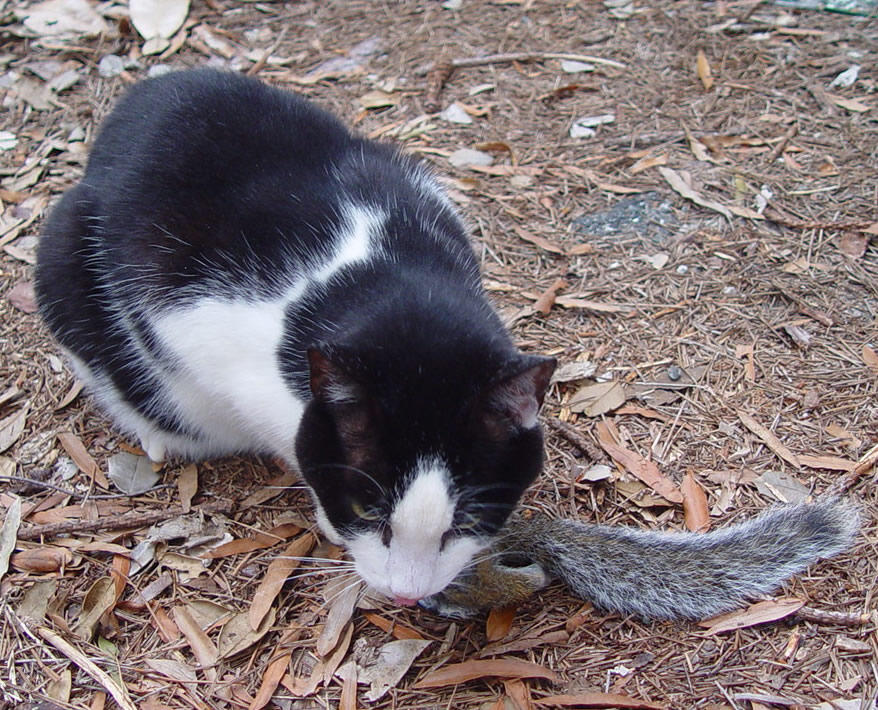
I had thought that the hunting days of our 13-year-old cat Bito were over. It's been almost a year since we've found any half-eaten vermin under our bed (his favorite spot for dining on fresh meat).

So I was happy to see him enjoying a breakfast of Unwary Squirrel Tartare as I left for work this morning.

We need to savor these late-in-life victories -- like Nicklaus winning the '86 Masters.

Way to go, Bito. I know you enjoyed every bite.

Tuesday, October 18, 2005

Something for Us Preservationists to Chew On

This challenging thesis pops up in an article from the NY Times on the rebuilding of New Orleans:

For decades now, the architectural mainstream has accepted the premise that cities can exist in a fixed point in historical time. What results is a fairy tale version of history, and the consequences could be particularly harsh for New Orleans, which was well on its way to becoming a picture-postcard vision of the past before the hurricane struck. (Read the whole thing.)
To what extent is that also true of designated historic areas in cities all over the U.S. and Europe? And for my own neighborhood?

Is it possible that preservationists like me, in pursuit of preserving the authentic architecture of the past, might actually be creating an inauthentic present?

And if that's the case, what's the best way for us to proceed if we think that old architecture has an important contribution to make to modern life?

Udate: David Boyd sends another view from the WSJ's Opinion Journal. The National Trust for Historic Preservation's Richard Moe says Hold Back Those Bulldozers.

Monday, October 17, 2005

I've Harnessed the Economic Power of the Blog!

Ross Meyers says Greensboro is "5 seconds behind the curve" because we haven't figured out a way to make money by blogging.

Hah. I've got that problem licked.

Yesterday evening I started a new blog, Dave's Tag Sale, which I intend to use for selling stuff I own but don't need any more.

I posted a photo and description of an antique dresser that I wanted to sell, and I displayed the photo and a link in the sidebar of this blog (A Little Urbanity) with the catchy, high-tech marketing phrases Urbane Shopping! and Visit Dave's Tag Sale!

Less than 24 hours later I was loading the dresser into a buyer's SUV with $400 in my pocket.

Needless to say, I'll be putting more items on display at Dave's Tag Sale very soon.

And with the $2.05 I've received from Altmedia101.com for advertising, I'll soon be filthy rich. Filthy, filthy rich, I tell you.

Now I'm 5 seconds ahead of the curve!

GDOT Mystery Solved

I received a very speedy and polite response from GDOT's Adam Fischer today regarding a parking mystery on Cypress Street.

It turns out that GDOT was in fact making an effort to be responsive to a resident's concern about a particular parking problem. Adam wrote me,

We were contacted by [a resident] several weeks ago about a concern with parking along Cypress Street.

Teachers were parking all day on the School side of Cypress Street and there were not enough spaces on the resident’s side of Cypress Street for parents to park to pick-up children/visit the School.

We decided to limit parking on the School side of Cypress to 2 hours from 9AM to 4PM so that teachers would not park there all day. The 2 hour time limit would allow for parents to park on the School side of the street in order to pick-up children/visit the School, and would free up parking spaces for residents on the other side of the street.
The problem of traffic during student pick-up times has been a cause of irritation in the neighborhood, and GDOT was trying to address that, and we appreciate it.

But when many residents are affected by a decision, it's my view that they need to be consulted before it is made.

To that end, Adam has asked the neighborhood association to look at a compromise recommendation at our next meeting. Which we will do.

Thanks for a quick response, Adam.

Sunday, October 16, 2005

NIM City

Keith Debbage and Russell Smith wrote in this morning's News & Record about the many newly incorporated municipalities (NIMs) in the Triad (another name for them is exurbs). We have gained 15 of them since 1990. They write,

Triad residents have effectively voted with their feet by relocating to NIMs that offer a reduced tax burden, a lower cost of living, cheaper housing costs and minimal governmental interference . . . . they provide good schools (even though many are grossly overcrowded), strong neighborhoods, open space and residential subdivisions where children can ride their bikes in the street without fear.
Sounds like Nirvana, doesn't is? And it mostly is for the people who live there. But it isn't good for everybody. They go on,

Substantial numbers of mostly affluent and highly skilled workers are opting to leave large, established cities for either private gated communities or newly formed government entities in the suburbs. Many of these folks are highly creative and talented and contribute significantly to the local labor market and tax base. Some policy makers have even suggested that the end result of such a brain-drain is that the larger cities of a region may be vulnerable to a declining tax base, deteriorating public schools and diminished public services if they are unable to consistently attract the most talented workers.
D'ya think? (Isn't that pretty much what happened to dozens of major cities in the 60s and 70s?)

Luckily, that doesn't seem to be happening (yet) to the Triad's cities, despite the rise of local NIMs.

But it might, unless our cities are able to find ways to make themselves attractive to those "highly creative and talented" people. Debbage and Smith finish,

. . . a key challenge for the Triad continues to remain getting all our community's oars to row in the same direction. The future health of the region depends on it, and a balkanized political landscape makes the challenge that much more rigorous.
But people leave the bigger cities precisely because they want to row their own boat, don't they?

Obviously, I'm a proponent of keeping more of us here in one big trireme, as a better way to promote not only our regional interests, but our well-being as members of a community.

If the smartest of us are scurrying off to private, semirural nirvanas while our cities become economic and social sinkholes, it's very unlikely that the Triad will be able to generate enough economic oomph to compete with the likes of Charlotte and the Triangle.

GDOT's Mysterious Ways

The Greensboro Department of Transportation has been doing some sidewalk repair on Cypress Street in my neighborhood. That's very much appreciated, because our sidewalks are well-used by dog walkers, baby strollers, exercisers, kids, etc.

For reasons entirely unknown, however, the unrestricted parking on that same street in front of Aycock Middle School has been suddenly changed to a 2-hour limit from 8 a.m. to 6 p.m. None of the neighbors I contacted on Cypress Street had been consulted or informed -- it just happened.

One resident, who has already lost a driveway to GDOT when the city decided to widen Yanceyville Street, now cannot park his car all day across from his house -- something he needs to do on trash pickup days.

Other neighbors need the parking for daytime visitors.

No neighbors had ever expressed any problems about parking on Cypress to the neighborhood association. So the obvious question is, who made the change, and why?

One neighbor speculated,

It really looks like another boneheaded act by a mid-level minor functionary at city hall.
It does look that way, doesn't it? Because now, for residents to use the parking as they have in the past, they will have to try to convince the city to issue residents-only on-street parking stickers like those that are used in College Hill.

Now tell me, what exactly is the point of changing the parking on a street that had no parking problems in the first place, so that citizens are required to seek an even more bureaucratic solution to something that was itself a "solution" to a non-problem?

It doesn't seem to make a lot of sense.

Friday, October 14, 2005

Mr. Sun Has Gone Too Far

I don't mind if you call me out, Mr. Sun. But when you go after my son -- watch out:

Solem stultum et morum nunc cano
Qui animo scribis insano.
Si liberum increpes
Sine mora invenies
Meum conditum pedem in ano.
Take that, you mewling facsimile of a psuedonymous humorist. Now beg for your translation.

Thursday, October 13, 2005

Behind the Planning Curve

Big news on regional planning from this morning's News & Record:

GREENSBORO -- A "Heart of the Triad" development is moving forward with some financial help from the local business community.

A $400,000 study will be done by the Piedmont Authority for Regional Transportation [PART] to determine the best use of a 7,500-acre tract of largely undeveloped land in the center of the Triad.

People have been talking about the need for regional planning in the Triad for years, and UNCG urban geographer Keith Debbage recently made a powerful case for it in the News & Record -- so it's nice to see a plan finally get underway.

The unusual thing about this effort, however, is that it's being paid for partly by the business community. I guess business leaders finally just got tired of waiting for the politicians to get it going.

Greensboro Mayor Keith Holliday wasn't happy about the local Chambers of Commerce sticking their oar in.

PART already has a $200,000 commitment from the N.C. Department of Transportation for half the study's expenses.

"I've never seen a situation where a public body would create a public plan and not pay for it," Holliday said.

But if the Chambers of Commerce had the time and energy to rustle up $200,000 for planning, why couldn't the Greensboro City Council and the Guilford County Commissioners have been doing the same thing?

When it comes to planning, I think, those two bodies just don't get it.

That might be because they have traditionally close relationships with the local building industry (represented by the lobbying group TREBIC), which is reflexively averse to such planning.

TREBIC doesn't like governments telling it where and what to build. A sign of this is the steady stream of requests from local developers to amend Greensboro's Comprehensive Plan -- requests which the City Council nearly always grants.

But builders and realtors are not the only business in town. The Chambers of Commerce represent a broader base of economic interests, and they see strong economic advantages in good land-use planning.

So the Chambers of Commerce are leading the planning charge, while local governments are playing catch-up.

Wednesday, October 12, 2005

Yom Kippur For Everybody

The sun is setting as I write this, and Yom Kippur is starting.

Ed Cone suggests we make it a national holiday -- or adopt a secular version of it, devoted to introspection and atonement.

I say to heck with the secular version. It's hard to make sense out of atonement in s secular context anyway.

Let's just have it as a national holiday, and let people deal with the religious implications as they will. We could all use a litle (a lot?) of sober introspection, atonement, renewal, and joy, which is what Ed says Yom Kippur is all about.

Tuesday, October 11, 2005

Dog Bites Man

From the Uninformative Headlines Department:

"Anthropologists Uncover Ancient Jawbone."

What'll be next? "Ford, Chrysler, GM Make Cars"?