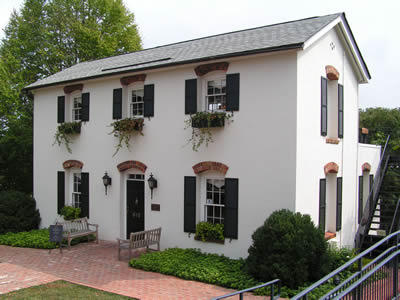
Action Greensboro loaded a couple of buses full of city & county political leaders, high-ranking city staff members, business movers & shakers, press people, philanthropists, and a couple of ne'er-do-wells (me and
Hoggard), and hauled us all down to
Greenville, SC last week for a look at that town's successful downtown revitalization.
First things first: thank you to the gracious people at Action Greensboro for an enlightening and entertaining trip, and to the many people in Greenville who educated and entertained us.
Here follows an account of what I saw.
Greenville is a small town of about 54,000 that has a big-town downtown. Downtown Greenville has 80 restaurants, a luxurious downtown hotel, a sports arena, a concert hall, a beautiful downtown park, and a booming downtown residential real estate market.
The question on everybody's mind was,
how did they do it? We got the answers in increments.
DOWNTOWN BUS TOUR
When we reached Greenville, we were treated to a short, guided bus tour of the downtown area, with commentary on my bus supplied by Greenville's young and articulate director of economic development, Nancy Whitworth. She emphasized 3 things that have been key to Greenville's success:
(1) Greenville's Mayor Knox White takes a keen interest in the details of urban planning. She noted, for example, the mayor's enthusiasm for "sidewalk lawns" -- the little strip of grass between the sidewalk and the street -- because they make pedestrians feel safe and comfortable while waking on busy streets. She said that the city council, too, is "open to new ideas about urban planning and design."
(2) Greenville has adopted design standards for downtown development and has preservation standards for the historic districts adjacent to downtown. Whitworth attributed the attractive appearance of new condominiums and businesses to these standards, and noted that all new construction -- "even if you want to change a sign" -- must be approved by the Design and Preservation Commission, which is similar to Greensboro's Historic Preservation Commission.
(3) Greenville has entered into many "public-private partnerships" (about which more below) to spur development. One of these is a new baseball stadium downtown, which is currently under construction, and which apparently was the object of considerable controversy (imagine that!).
WORDS FROM THE MAYORAfter the tour, we heard a presentation from Mayor Knox White himself in Greenville's 70s-modern icky council chamber. (The original Romanesque revival city hall was torn down).
Mayor White said that Greenville's downtown renaissance began in 1971 when the city hired a San Francisco landscape designer to plan a streetscape for Main Street, and that efforts have been ongoing since then. The mature trees planted in the early 70s give Main St. much of its current appeal.
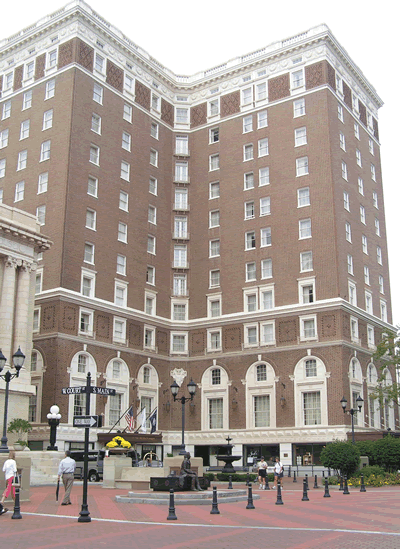
The mayor said that the biggest turning point in the downtown's success was the outstanding restoration of the 1920s-era
Poinsett Hotel. "Don't doubt the power of historic preservation as an economic development tool, or as a political tool," he said. "We really got everybody on board when they saw how beautiful the Poinsett was, especially the older folks."
HISTORIC WALKING TOURI took the walking tour led by Robert Benedict, who is both a
real estate developer and the chair of Greenville's Design and Preservation Commission. After a lunch at the charmingly restored
Mary's Restaurant,

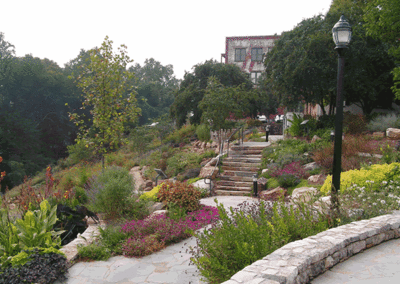
he showed us some of the more successful historic rehab projects in Greenville, including a downtown park,
the Poinsett Hotel,

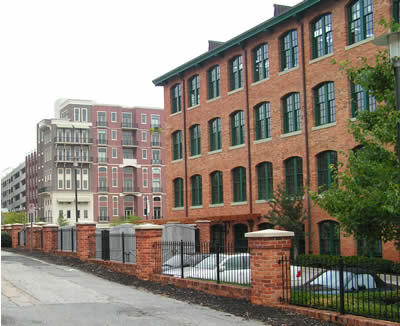
and a restored mill that serves as restaurant and office space.
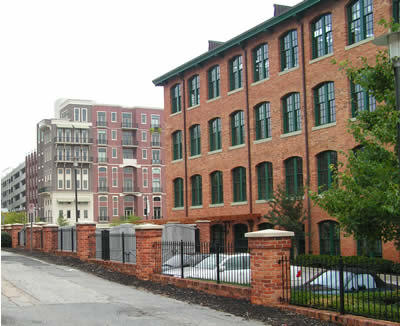
(Note the new condominiums to the left, with their parking garage behind the building facade.)
Greenville has a good stock of historic downtown buildings, some of which are being put to good use, but some of which are also vacant and uncared-for. On the whole, I think Greensboro's inventory of reasonably well-maintained historic buildings is as good or better -- though we do lack the Poinsett.
PUBLIC-PRIVATE PARTNERSHIPS
After the walking tour, we got a briefing on the public subsidies that helped make all this happen in Greenville.
"Public-private partnerships" was the watchword and mantra of how Greenville government has pushed downtown growth forward. The city has used a number of innovative ways to boost investment.
For example, in order to entice developers to build this building,

the city offered to build and maintain a parking garage beneath it for its tenants and for the public. The city owns the land; the developer owns the "air rights" -- whatever they build on top of the garage.
Greenville seems to have built such crypto-parking decks (I call them that because they always hide the parking behind a residential or retail facade) for a number of projects; for other undertakings, such as their downtown baseball stadium, the city donated the land or offered other incentives to private investors.
Greenville government has taken financial risks and incurred debt to an extent that widened the eyes of Greensboro Interim City Manager Mitch Johnson and his retired boss Ed Kitchen, who, at one point in the presentation, exchanged looks of amazed incredulity.
URBAN PLANNING
But Greenville has not done this without an overall urban plan that is well understood by city elected leaders and staff.
"Build anchors" was the advice given several times. And so Greenville did. They have invested in major attractions like the
Peace Center concert hall, the Poinsett Hotel, the
Bi-Lo Center, and the
West End Market, all in walking distance from one another. They have connected them with high-quality pedestrian corridors that display fine brickwork, landscaping, pleasant little corners to sit and rest, and a generous scattering of public art.
Most impressive to me, the city has been fearless in pushing major anchors like their baseball stadium and the West End Market into truly blighted areas where private developers had feared to tread, hoping to draw them out of their comfort zone. It's working.
"Distribute parking" was the other main piece of advice from Greenville's leaders. The city deliberately did
not place big parking decks right next to their anchors in order to generate pedestrian traffic -- and business -- for restaurants and downtown retail.
GETTING TO GREENVILLE
Can Greensboro get to Greenville in terms of downtown development? That will depend on the answers to these questions:
Will Greensboro find the economic and political value in historic preservation that Greenville has found? Will there arise in Greensboro a new class of developer-preservationists
a la Robert Benedict who will bring to preservation an entrepreneurial spirit that will spur both civic pride and investment?
Will Greensboro's elected officials develop a heretofore unaccustomed, top-to-bottom interest in urban planning, and a resolve to devise a cohesive and detailed development plan for downtown, with well-placed anchors and first-quality pedestrian amenities? Will they stick to this plan over a period of a decade or more and dedicate themselves to persuading the public of its value? Will they commit public resources to it?
Will Greensboro enter into "public-private partnerships" in order to facilitate the construction of major anchors downtown? Will elected officials have the political will to get out in front of the private sector and place those anchors in areas that really need them, like South Elm St.?
I'll let you answer the questions.