My new neighbor Justin Smith sent me a link to Weekend America's audio tour of Kentlands, in Gaithersburg MD, an early experiment in new urban design. The good news: it's clean and convenient. Most residents seem to like it a lot. The bad news: it's not good skateboarding territory.
It's followed by a story about rebuilding Biloxi, Mississippi, where the Congress for the New Urbanism just held a week-long new urbanist charrette. Some Biloxi residents seem to like what they see.
You have to scroll down to the second hour for the audio on both stories.
Monday, November 14, 2005
New Urbanism Audio: Kentlands, Biloxi

Small Town, Big Town Preservation Conflicts
New York City's preservation community seems to be in relative decline:
Sound familiar?The [New York Landmarks Preservation] commission's power to protect a building in virtual perpetuity - and its willingness to use that power - made it the most powerful such agency in the United States. Its chairmen were often willing to stand up to the mayor when they felt a principle was at stake.
The gradual shift away from those convictions had its seeds in the fiscal crisis of the mid-1970's, which spurred the rise of public-private partnerships with developers. Developers gained increasing power over how the city was shaped. Playing on the public's fear, many politicians argued that the only alternative was a descent into blight and crime. (Read the whole thing.)
This kind of conflict isn't all bad, though.
The tension between preservationists and developers is usually a sign of a city's underlying economic health. Places where nothing old has been torn down are often economically stagnant; the old buildings are there because nobody has the money to build something new.
But towns with no effective preservation can be homogenized and dull, lacking a sense of place, history, and identity.
The trick is to preserve architecture that's really good, significant, and place-making, while encouraging new buildings that themselves will be worth keeping around for a long time.
Sunday, November 13, 2005
Another Successful Historic Rehabilitation
 This espresso pot has belonged to my wife Laurette since 1979. She bought it at the original Starbuck's store at Pike Place Market in Seattle, and has used it every day since then. In the 80's she saw this model in a San Francisco art gallery as an example of great Italian design.
I remember pouring her a cup from it on the day we brought Sam home from the hospital, as I cradled him in my free arm. (Newborns require lots of coffee -- for the parents).
About a month ago it was as tarnished and blackened as you would expect after 26 years of continuous use. "Wouldn't you like that cleaned up a little?" I asked. "No! It won't make good coffee any more!"
But I spirited it away to Jae-Mar Brass and Lamp Company on South Elm when she took a business trip to California (Jae-Mar restored all the metal fixtures, hinges, doorknobs, etc. at Vick Commons), and she was very pleased with the result. It cleaned up good, didn't it?
And it still makes great coffee. We're drinking Zona Alta these days, a shade-grown Salvadoran coffee imported by some of Laurette's inlaws. Mmmm.
How Do You Like Me Now?
This house on MLK Boulevard overlooking Lee St. stood in a state of severe disrepair for the first 12 years that I lived in Greensboro. I heard more than one person say that it was an eyesore beyond fixing that needed to be torn down. A private investor (I don't know who) has brought it back to life: I can hear it saying to me, "How do you like me now?" (with apologies to JW).
Have a look at the decorative brackets and the curved tops on the window casings. I wonder how much it would cost to build something like this new; I'm pretty sure it would cost much more than the renovation.
This house is one of the few left in this style (I'm pretty sure it would be called "eclectic Italianate") in Greensboro. Thanks to whoever performed the resuscitation.
Saturday, November 12, 2005
Pinching the Arteries
Jason Hardin's Fast Forward column in today's N&R (not posted) puts its finger on why there's relatively little pedestrian traffic in many places downtown:
Many streets are wide, multi-lane routes with one-way traffic. This tends to encourage higher speeds. And that, in turn, helps to make roads such as Market, Eugene, and Edgeworth streets and Friendly Avenue unpleasant to walk along.That's certainly been my experience: those streets have sidewalks, but the pedestrian experience on them is pretty bleak.
I remember when my hometown of Davenport, IA instituted multi-lane one-way streets downtown in the early 70's in an effort to help its struggling downtown. Didn't work: everyone just drove through really fast.
As Barry Cullingworth says about those road projects,
Paradoxically, these began as an attempt to rescue the cities from decline: they were seen as providing easy access to the city. Unfortunately, it was not perceived that they might equally well provide easy exit.Actually, Greensboro has had some recent successes in accommodating both cars and pedestrians.
--Planning in the USA (Routledge: 2003) p. 34.
The East Market Street corridor project-- for which they actually narrowed the street -- and Southside both have really nice places to walk because the planners included design elements that make pedestrians feel good.
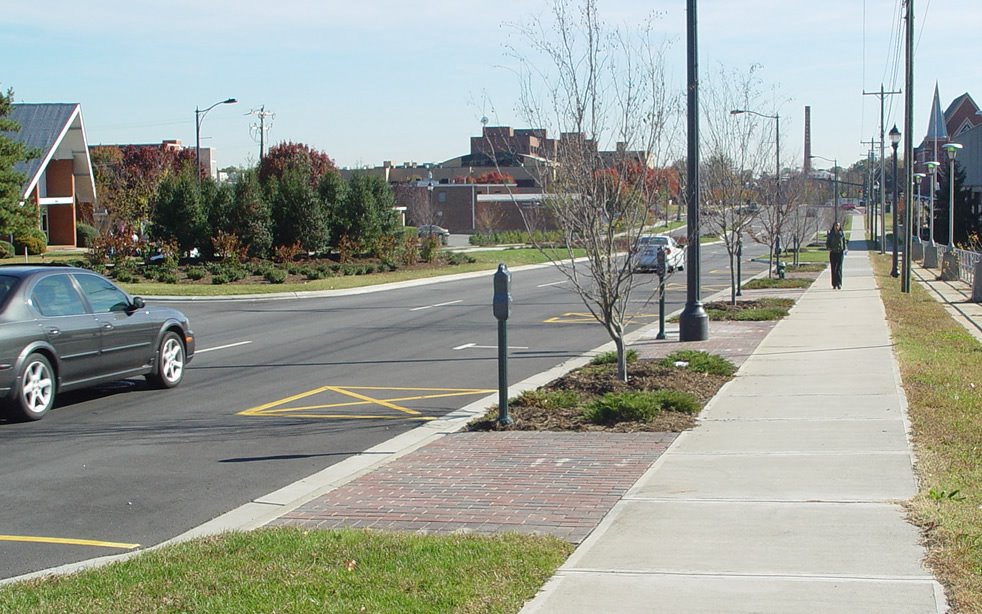 Here on East Market you can see that they included landscaped "curb lawns" and planted trees in them, which give pedestrians a sense of protection from passing cars. In the picture below, from Southside, a decorative brick border is used for a similar effect because there's less sidewalk to work with.
The border not only looks nice, it keeps you from feeling like you're walking really close to the street (even though you are). On-street parking helps, too.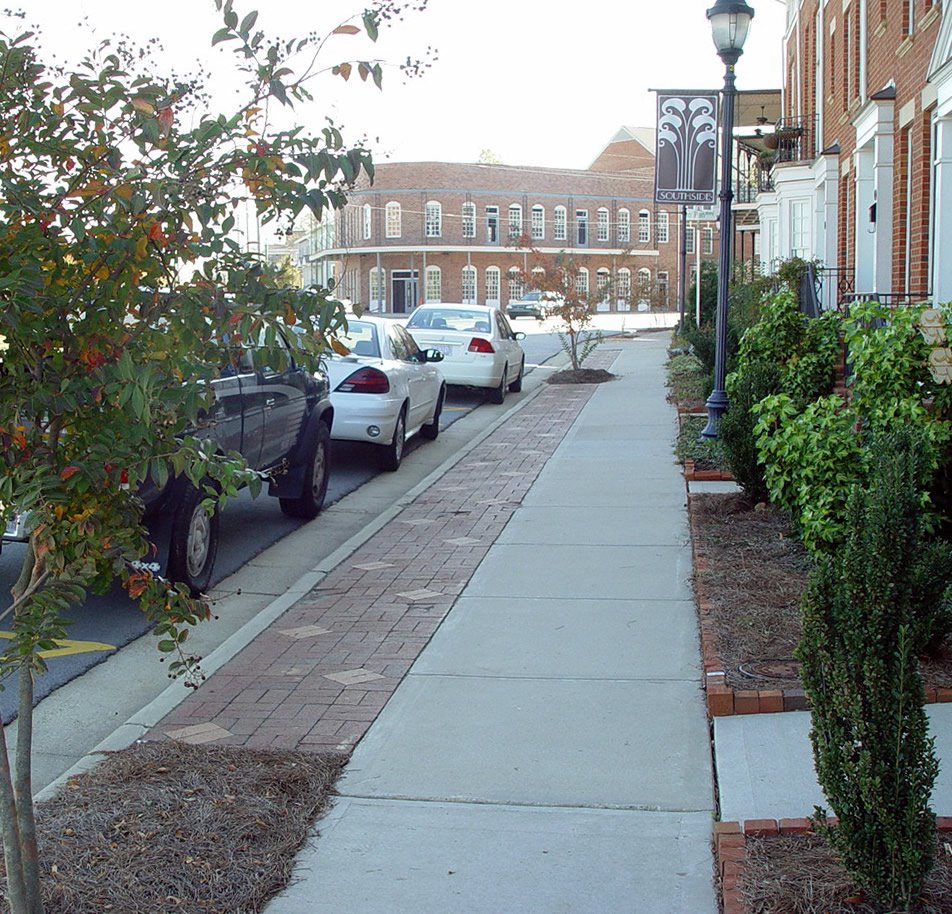 This crosswalk on E. Market makes crossing a lot less daunting than it used to be, and the brick piers give a sense of safety from fast-moving cars.
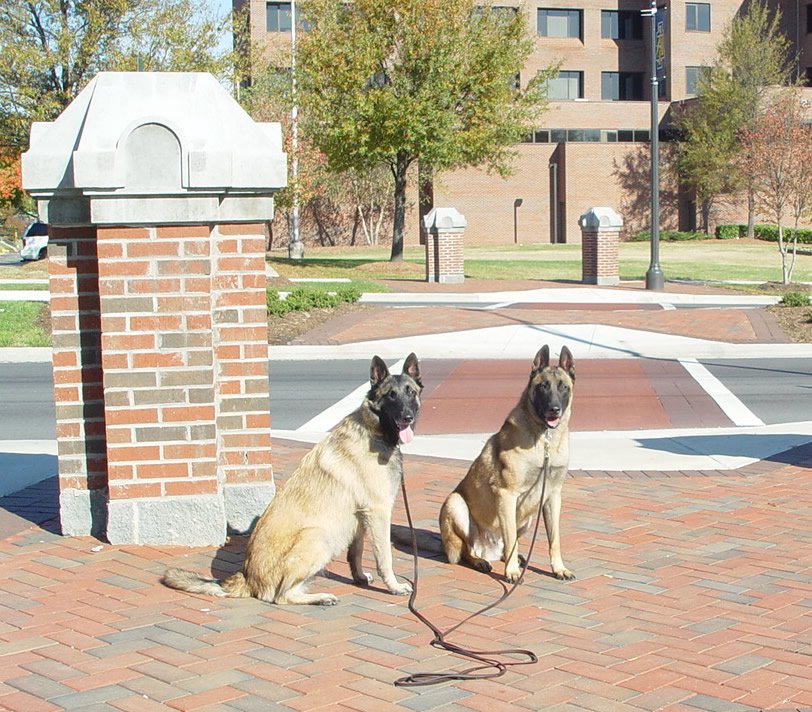 Dogs like them, too. (And didn't they do a great sit-stay for the photo?)
Both of these award-winning projects originated in Greensboro's Department of Housing and Community Development, run by Andy Scott and his talented staff.
I wonder whether any new projects like these will be generated at the political level by our new city council, rather than at staff level as has been the case so far.
Friday, November 11, 2005
De Tocqueville in Aycock
I argued in my previous post that good preservation can be good economics; last night my neighbors and I heard evidence of that which almost stunned even me, a true believer.
Bill Christian of William Christian & Associates presented the results of a market study of our neighborhood which they performed as a part of the Summit Avenue Corridor Study. The study area included about 1,000 acres with the Aycock Historic District at its center.
Amid lots of other good news, Bill reported that residential real estate in the study area had appreciated 53% in the last decade, which is twice the rate for the city of Greensboro as a whole.
I'm pretty sure that the rate in the historic district itself is higher than 53%. A neighbor who has been planning to sell his house and retire to the country told me that he was putting off his plans because his own research shows that the historic houses are appreciating at about 10% a year. Part of that increase is driven by renovation investments that my neighbors are making.
I know it's counterintuitive to many free-marketers (including me) that an intrusive regulatory mechanism like the Historic District Design Guidelines should actually encourage investment -- but facts is facts. I don't care if you're Milton Friedman: the data here and elsewhere show that that's what's happening.
But there's something else at work as well. Alexis de Tocqueville, the 19th-century Frenchman who wrote about American democracy, admired Americans' peculiar tendency to form small associations, though more recent writers have noted the waning of tendency.
I attribute a good deal of the the economic strength in our area, which, according to Bill Christian, includes strong employment, rising incomes, and increasing demand for high-quality retail, to the activity of our small-scale associations. Groups like the Summit / Bessemer Business Association and my own neighborhood association have worked hard to focus city services and resources on our area, and obviously it's working.
Alexis is smiling on us.
Wednesday, November 9, 2005
Cedar Street Economics
What to do with the Cedar Street neighborhood?
As one resident said in Jim Schlosser's N&R story today, "this area is up for grabs." Developers are moving in, a number of buildings have already been torn down, so the city has scrambled to come up with a plan to guide development and promote preservation at the same time.
Some see preservation and development as being at odds with one another; Councilman Tom Phillips was quoted in the Rhino Times as saying the neighborhood should be bulldozed for new development. For a lot of people, "new development" means "new buildings."
Actually, a tremendous amount of development -- meaning economic activity -- goes on in existing, historic buildings.
But the renovation economy is not very appealing to politicians because, while it's very easy to point out crisp, new condominiums to constituents and potential new businesses and say, "look what we did!" it's a little harder to point to a multiple-income neighborhood of long standing -- even one that looks pretty good -- and say, "our policies encouraged millions of renovation dollars here, but it's kind of hard to see it, so you'll have to take my word for it."
Here are some things about the renovation economy that Tom and others might want to keep in mind (most of which I gleaned from reading Don Rypkema's stuff on the economics of preservation).
Rehab projects typically require more skilled labor than new construction -- they're simply more challenging than an average framing-and-sheetrock job. That means higher wages for local workers. For the rehabber, the cost of higher wages is offset by the fact that he doesn't have to build from scratch.
If the rehab is being done on a historic property, it might qualify the investor to get up to 50% of his investment back in state and federal tax credits. That means that the local economy not only gets the benefit of the rehab, but half as much again from state and federal coffers will be flowing into the local economy.
Rehab jobs tend to be done by small, locally based companies, unlike big, new developments, which are often built by huge, national companies that take their profits out of town and out of state. If you want to support local entrepreneurs like my neighbor Pete Williams (cabinet maker), my contractor friends David Milsaps, Joe Bower and Joe Thompson, or local window repair expert David Hoggard, rehab is the way to go.
Some features of historic houses have hidden value. Old-fashioned "wavy" glass goes for about $22 a square foot on the free market these days . We saw a rehabbed building in Greenville that used recycled old glass in its new windows -- it must have cost them a fortune! -- but if those Cedar Street houses are torn down, that resource will most likely go into the landfill.
The same goes for things like heart pine flooring, oak mantels, 6" heart-pine turned porch posts, decorative brackets, 6" milled window and door casings, etc. These items will only appreciate in value as they become more rare. You can't get heart pine any more, because it comes only from old-growth pines, and the lumber companies can't afford to let a pine tree grow 100 years any more.
On the other hand, if you want to favor bigger businesses who hire lower-wage laborers, and if you're interested in a newer-but-blander neighborhood that will be an economic monoculture and that will probably display less craftsmanship and style, and will probably look a lot more like condo projects being built all over the U.S., well then bulldozing Cedar Street and building new is the way to go.
UPDATE: Here is a copy of the Cedar Street Strategic Plan that will go before city council on November 15, 2005.
Welcome to Summerfield, NC . . .
. . . now go home.
At least, that's how I read Elizabeth Edmonds's feelings in her "Counterpoint" guest op-ed in this mornings N&R. She asks Greensboro's young families who are moving to exurban Summerfield,
Why do you young whippersnappers move into 'charming' communities like Summerfield to get away from hectic city life and then proceed to drag business and development into the charming community until it looks just like the place you left?She eulogizes the small-town pleasures of hanging out at the feed store and shooting the breeze with friends, and bemoans the nine new subdivisions and "big government on a local scale" that the newcomers have brought, along with their demands for more services and amenities.
It's a classic paradox, isn't it? And it applies not only to urban development but also to things like tourism (even eco-tourism) and dining.
People who are enthralled by the pristine environment of the Antarctic traipse down there and stomp the native lichens to death while they're bugging the penguins. They find a great little restaurant and talk it up to their friends until "nobody goes there anymore; it's too crowded" (as John McNulty -- not Yogi Berra -- once said.) Anthropologists go to distant jungles to study tribes unsullied by the modern world, only to find that their subjects would like to have an iPod Nano just as much as any suburban teenager.
But I got kind of a kick out of Edmonds talking about "hectic city life." In Greensboro?
Hah. There's a reason this blog is called A Little Urbanity, you know.
Monday, November 7, 2005
Just North of Kansas City, Actually
 I ended up spending most of the weekend in Atchison, KS, stopping in Kansas City only to rent a car and then to drop it off at the airport.
If you're old enough, you probably know Atchison from the song, On the Atchison, Topeka, and the Santa Fe. When I told the 30-something rental car clerk in KC that I was going to Atchison, she gave me a blank look. I said, "You know, like in the song -- the Atchison, Topeka, and the Santa Fe." Another blank look, then she drawled, "Well, I got a map to Topeka. I can get you there OK."
If you're an aviation buff or knowledgeable about feminist history, you probably know that Atchison is the hometown of Amelia Earhart, the world's sexiest aviatrix.
Atchison also has block upon block of mid-19th to early 20th-century houses, a lot of which are in decent to excellent condition. And I forgot to bring my digital camera.
I know you're all just broken up that I don't have pictures of old houses in Atchison.
Hah! Don't despair. I bought two disposable cameras, and will have pictures for you soon! -- not only of the houses, but of a really nice mid-century modern Benedictine church done by one of Frank Lloyd Wright's students, and of the Amelia Earhart Memorial Bridge across the Missouri River.
Friday, November 4, 2005
Goin' to Kansas City
Kansas City, here I come (to take care of some urgent business).
So I'm missing the Loewenstein Tour that UNCG and PGI are hosting. Darn.
You go for me.
Wednesday, November 2, 2005
Fall Kids' Books
For the first time in about 15 years, Laurette & I didn't really do anything about Hallowe'en costumes this year. Our two older kids are teenagers and don't trick-or-treat any more, and our youngest dressed up as an 80's girl and went to a party.
It's a bit melancholic, since I really liked that stuff.
And that put me in mind of other things we used to do with our kids, but don't any more, like read to them at bedtime.
So I'm cheering myself up a little by lising some of the kids' books I liked best. I don't know whether these were the kids' favorites, but they were my favorites.
A great one for fall: The Ghost-Eye Tree by Bill Martin, Jr. and John Archambaud, Illustrated by Ted Rand. I love the liveliness and innocence of Rand's illustrations. Like a lot of great kids' books, not much really happens . A brother and sister go on an errand and have to pass a spooky tree, but it's full of love, heart, and humor. (Honorable mention by the same guys: Barn Dance.)
Also good for fall: John Brown, Rose, and the Midnight Cat. A story of an old woman's serendipidous relationship with a cat. (But aren't all relationships with cats seredipendous?) This is really Laurette's favorite, as she's more of a cat person than I.
For the really cold weather: Up North in Winter. A workingman in the Iron Range misses his Friday night ride home from work, and has to walk across a frozen lake to his just-barely-making-ends-meet family. They all have a surprising encounter with an apparently frozen fox. A big warm-fuzzy.
Also for winter, The Mitten by Jan Brett. Brett's intricate illustrations are always pleasing, and her skill finds its best medium in this folktale about animals trying to keep warm.
I'm out of time, though there are lots more I could list. Add favorites at will.

Tuesday, November 1, 2005
Suburban Unrest
In Planning in the USA, Barry Cullingworth and Roger Caves point out that suburbs in the United States before the 20th century tended to be places of poverty, substandard living, and degradation.
Even in the early 20th century, my Dad used to tell me, shantytowns lay at the outskirts of midwestern towns in Illinois.
At some point, though, that pattern was reversed in the USA.
Not in Paris, though. CBS News reports that Paris's poor, immigrant, suburban population is rioting.
Suburbs that ring France's big cities suffer soaring unemployment and are home to immigrant communities, often from Muslim North Africa. Disenchantment, and anger, run high.Why is it that unemployment, anger, and and racial/ethnic ghettoization are characteristic of the USA's center cities, but of Paris's (and Europe's?) suburbs? Why did the European middle and upper-middle classes stay in town?
Subscribe to:
Posts (Atom)